A Curious Miscellany of Items Philosophical, Historical, and Literary

Manus haec inimica tyrannis.

Thursday, January 4, 2018

The Spectacled Avenger's Reading List, 2017

In keeping with a tradition of long standing on this blog, the first post of the new year is devoted to the list of books I’ve read over the course of the previous year. As usual, if the entry is in bold, it means I particularly enjoyed that book (no reasons provided). If an entry appears more than once, it’s not a mistake; it means I read the book more than once.

One of the joys of this exercise accrues more to me than to you, dear reader. It offers me the opportunity to step back and look at what I was interested in, discern any patterns therein, and compare see how these may have differed from earlier lists.

In looking at the 2017 list, at least two things remain unchanged from 2016: First, relatively little of what I read dates from later than the 19th century. Second, I have continued to read more fiction that has historically been the case. Conspicuous here is my Jane Austen binge. I would include under “fiction” the plays I read, Jacobean or otherwise (Sophocles, Jonson, Shakespeare, Middleton, Ford, Etherege, Vanbrugh). And of course, there’s the poetry (Lydgate, Carew, Rochester, and plenty of Pope).

In terms of differences from previous years, I suppose there are fewer classical authors, though Homer, Horace, Martial, and Sallust are represented. New to the list are the early travelers’ accounts of America (Chastellux, Hamilton, Trollope). I also read a fair amount of Coleridge’s prose, which is passing strange, since I can’t honestly say I enjoyed much of it.
 

*        *        *        * 

ADAIR, Douglass. Fame and the Founding Fathers. Trevor Colbourn (ed.). New York: W. W. Norton, 1974.

ADAMS, Abigail. Letters. Edith Gelles (ed.). New York: Library of America, 2016.

ADAMS, John Quincy. Diaries (Vol. I: 1779-1821). David Waldstreicher (ed.). New York: Library of America, 2017.

ADAMS, John Quincy. Diaries (Vol. II: 1821-1848). David Waldstreicher (ed.). New York: Library of America, 2017.

AUSTEN, Jane. Emma. London: Folio Society, 1975.

AUSTEN, Jane. Sense and Sensibility. London: Folio Society, 1975.

AUSTEN, Jane. Persuasion. New York: Everyman's Library, 1992.

AUSTEN, Jane. Mansfield Park. New York: Everyman's Library, 1992.

AUSTEN, Jane. Northanger Abbey. New York: Modern Library, 1995.

BACON, Francis. The Essayes or Counsels Civill and Morall. Norwalk, CT: The Heritage Press, 1972.

BEVERLEY, Robert. The History and Present State of Virginia. Susan Scott Parrish (ed.). Chapel Hill: University of North Carolina Press, 2013.

BROWN, Charles Brockden. Edgar Huntly, or, Memoirs of a Sleep-Walker. Norman S. Grabo (ed.). London: Penguin Books, 1988.

BROWN, Charles Brockden. Wieland, or, The Transformation. Amherst, NY: Prometheus Books, 1997.

BRUNI, Leonardo. History of the Florentine People (Vol. I). James Hankins (trans.). Cambridge, MA: Harvard University Press, 2001.

BRUYÈRE, Jean de La. Characters. Henri Van Laun (trans.). London: Oxford University Press, 1963.

BURKE, Edmund. Reflections on the Revolution in France and Other Writings. New York: Everyman’s Library, 2015.

BURKE, Edmund. Reflections on the Revolution in France (Select Works, Vol. 2). Indianapolis: Liberty Fund, 1999.

BURNEY, Frances. Evelina, or The History of a Young Lady’s Entrance into the World. Edward A. Bloom (ed.). London: Oxford University Press, 1968.

BUTLER, Joseph. Fifteen Sermons Preached at the Rolls Chapel and a Dissertation upon the Nature of Virtue. London: G. Bell and Sons, 1953.

CALHOUN, John C. A Disquisition on Government and A Discourse on the Constitution and Government of the United States. Charleston, SC: Walker and James, 1851 (facsimile, New York: Legal Classics Library, 1993).

CAREW, Thomas. The Poems of Thomas Carew. Rhodes Dunlap (ed.). Oxford: Clarendon Press, 1949.

CHASTELLUX, François-Jean, Marquis de. Travels in North America in the Years 1780, 1781 and 1782 (Vol. I). Howard C. Rice, Jr. (Trans.). Chapel Hill, NC: University of North Carolina Press, 1963.


CHASTELLUX, François-Jean, Marquis de. Travels in North America in the Years 1780, 1781 and 1782 (Vol. II). Howard C. Rice, Jr. (Trans.). Chapel Hill, NC: University of North Carolina Press, 1963.

CLARKE, John. An Examination of the Notion of Moral Good and Evil. London: A. Bettesworth, 1725.

COLERIDGE, Samuel Taylor. Collected Works, Vol. 2: The Watchman. Lewis Patton (ed.). London: Routledge and Kegan Paul, 1970.

COLERIDGE, Samuel Taylor. Collected Works, Vol. 4: The Friend. Barbara E. Rooke (ed.). London: Routledge and Kegan Paul, 1969.

COLERIDGE, Samuel Taylor. Collected Works, Vol. 10: On the Constitution of the Church and State. John Colmer (ed.). Princeton, NJ: Princeton University Press, 1976.

DONNE, John. Donne's Sermons: Selected Passages. Logan Pearsall Smith (ed.). Oxford: Clarendon Press, 1932.

ETHEREGE, Sir George. The Man of Mode. W. B. Carnochan (ed.). Lincoln: University of Nebraska Press, 1966.

FERRIER, Susan. Marriage, a Novel. Herbert Foltinek (ed.). London: Oxford University Press, 1971.

FIELD, P. J. C. The Life and Times of Sir Thomas Malory. Woodbridge, Suffolk: D. S. Brewer, 1999.

FIELDING, Sarah. The Adventures of David Simple. Malcolm Kelsall (ed.). London: Oxford University Press, 1969.

FITZGERALD, F. Scott. The Beautiful and Damned. New York: Modern Library, 2002.

FORD, John. ‘Tis Pity She’s a Whore. Martin Wiggins (ed.). London: Bloomsbury, 2003.

FORDYCE, David. The Elements of Moral Philosophy. London: R. and J. Dodsley, 1754 (facsimile, Bristol: Thoemmes, 1990).

HAMILTON, Alexander, John JAY, and James MADISON. The Federalist (The Gideon Edition). George W. Carey and James McClellan (eds.). Indianapolis: Liberty Fund, 2001.

HAMILTON, Thomas. Men and Manners in America (Vol. I). Edinburgh: William Blackwood, 1833.

HAMILTON, Thomas. Men and Manners in America (Vol. II). Philadelphia: Carey, Lea and Blanchard, 1833.

HOMER. Odyssey (Books 13-24). A. T. Murray (trans.). Cambridge, MA: Harvard University Press, 2004.

HORACE. A Poetical Translation of the Works of Horace (Vol. I). Philip Francis (trans.). London: W. Strahan et al., 1778.

HOUELLEBECQ, Michel. The Elementary Particles. Frank Wynne (trans.). New York: Vintage Books, 2000.

JOHNSON, Samuel. The Works of Samuel Johnson (Vol. II). London: F. C. and J. Rivington et al., 1823.

JOHNSON, Samuel. The Works of Samuel Johnson (Vol. III). London: F. C. and J. Rivington et al., 1823.

JONSON, Ben. Volpone. Alvin B. Kernan (ed.). New Haven, CT: Yale University Press, 1962.

KAMES, Henry Home, Lord. Elements of Criticism (Vol. II). Indianapolis: Liberty Fund, 2005.

LOVECRAFT, H. P. Tales. Peter Straub (ed.). New York: Library of New York, 2005.

LUTTRELL, Narcissus. A Brief Historical Relation of State Affairs from September 1678 to April 1714 (Vol. I). Oxford: Oxford University Press, 1857.

LYDGATE, John. Poems. John Norton-Smith (ed.). Oxford: Clarendon Press, 1966.

MACKENZIE, Henry. The Man of Feeling. Brian Vickers (ed.). London: Oxford University Press, 1967.

MALTHUS, Thomas Robert. An Essay on the Principle of Population (Vol. I). London: J. Johnson, 1806 (facsimile, Bristol: Thoemmes Press, 1996).

MALTHUS, Thomas Robert. An Essay on the Principle of Population (Vol. II). London: J. Johnson, 1806 (facsimile, Bristol: Thoemmes Press, 1996).

MARTIAL. Epigrams (Vol. II). D. R. Shackleton Bailey (trans.). Cambridge, MA: Harvard University Press, 1993.

MIDDLETON, Thomas. Selected Plays of Thomas Middleton. David L. Frost (ed.). Cambridge: Cambridge University Press, 1978.

MONTESQUIEU. Charles de Secondat, Baron de. The Spirit of Laws (Vol. I). Thomas Nugent (trans.). Dublin: G. and A. Ewing, 1751.

MONTESQUIEU. Charles de Secondat, Baron de. The Spirit of Laws (Vol. II). Thomas Nugent (trans.). Dublin: G. and A. Ewing, 1751.

NORTON, Andrews. A Review of “Men and Manners in America”, Reprinted from the North American Review. London: John Miller, 1834.

OSTADE, Ingrid Tieken-Boon van. The Two Versions of Malory’s “Morte Darthur”: Multiple Negation and the Editing of the Text. Cambridge: D. S. Brewer, 1995.

PALEY, William. The Principles of Moral and Political Philosophy (Vol. I). London: J. Faulder et al., 1814.

PALEY, William. The Principles of Moral and Political Philosophy (Vol. II). London: J. Faulder et al., 1814.

POPE, Alexander. The Dunciad (Twickenham Edition, Vol. V). James Sutherland (ed.). New Haven: Yale University Press, 1963.

POPE, Alexander (trans.). The Iliad of Homer. Steven Shankman (ed.). London: Penguin, 1996.

POPE, Stephanie et al. Cambridge Latin Course, Unit 1 (4th edition). New York: Cambridge University Press, 2000.

ROBERT III, Henry M. et al. Robert’s Rules of Order Newly Revised in Brief (2nd edition). Cambridge, MA: Da Capo Press, 2011.

ROBERTSON, William. The History of America (Vol. I). London: Cadell and Davies, 1808.

ROCHESTER, John Wilmot, Earl of. The Poems of John Wilmot, Earl of Rochester. Keith Walker (ed.). Oxford: Basil Blackwell, 1984.

RORABAUGH, W. J. The Alcoholic Republic: An American Tradition. New York: Oxford University Press, 1979.

SALLUST. The War with Catiline, The War with Jugurtha, Orations ad Letters. J. C. Rolfe (trans.). Cambridge, MA: Harvard University Press, 2000.

SHAFTESBURY, Anthony Ashley-Cooper, 3rd Earl of. Characteristicks of Men, Manners, Opinions, Times (Vol. I). Indianapolis: Liberty Fund, 2001.

SHAFTESBURY, Anthony Ashley Cooper, 3rd Earl of. Characteristicks of Men, Manners, Opinions, Times (Vol. II). Indianapolis: Liberty Fund, 2001.

SHAFTESBURY, Anthony Ashley Cooper, 3rd Earl of. Characteristicks of Men, Manners, Opinions, Times (Vol. III). Indianapolis: Liberty Fund, 2001.

SHAKESPEARE, William. King Lear. Kenneth Muir (ed.). Cambridge, MA: Harvard University Press, 1959.

SHIELDS, Jon A. and Joshua M. DUNN Sr. Passing on the Right: Conservative Professors in the Progressive University. New York: Oxford University Press, 2016.

SIDNEY, Sir Philip. Prose Works (Vol. III). Albert Feullerat (ed.). Cambridge: Cambridge University Press, 1963.

SMITH, Adam. The Theory of Moral Sentiments. D. D. Raphael and A. L. Macfie (eds.). Indianapolis: Liberty Fund, 1982.

SOPHOCLES. Ajax, Electra, Œdipus Tyrannus. Hugh Lloyd-Jones (trans.). Cambridge, MA: Harvard University Press, 1997.

SPINGARN, J. E. (ed.). Critical Essays of the Seventeenth Century (Vol. III: 1685-1700). Bloomington: Indiana University Press, 1968.

TROLLOPE, Frances. Domestic Manners of the Americans. London: Folio Society, 1974.

VANBRUGH, Sir John. The Relapse. New York: W. W. Norton, 1986.

VINOGRADOFF, Paul. Roman Law in Mediæval Europe. New York: Harper and Brothers, 1909.

WIDDOWSON, Frances and Albert HOWARD. Disrobing the Aboriginal Industry: The Deception Behind Indigenous Cultural Preservation. Montreal and Kingston: McGill-Queen's University Press, 2008.

WINDHAM, William. Speeches in Parliament, of the Right Honourable William Windham (Vol. I). London: Longman, Hurst, et al., 1812.

WINDHAM, William. Speeches in Parliament, of the Right Honourable William Windham (Vol. II). London: Longman, Hurst, et al., 1812.

 
WINDHAM, William.
Speeches in Parliament, of the Right Honourable William Windham (Vol. III). London: Longman, Hurst, et al., 1812.


Monday, December 4, 2017

The "Dublin 1743" Edition

Detail from John Brooks' portrait
In his 1967 paper “English Editions of Shaftesbury’s Characteristics” (mentioned previously), William Alderman compiled a list of editions of Shaftesbury’s book, from which he excluded ones that were merely apocryphal, ones for which he could not track down and examine a physical specimen. Among these was a “Dublin 1743” edition. What he wrote of that edition is worth quoting at length: 

“Some years ago a reputable London bookseller offered me a ‘Fourth Edition. Dublin. 1743 (Vol. 2 and 3 dated 1723) 3 Vols. 8vo.’ In reply to a questioning letter that I sent him, he confirmed the claim that Vol. I was dated ‘Dublin 1743’ and that it was described on the title page as ‘The Fourth Edition.’ I ordered it immediately, but was told that this item had already been sold. I then asked that the sale be traced, but was told that not a private collector but another bookseller had purchased it. This second company could not trace the resale. I then wrote the Library of Trinity College, Dublin, but was told that neither it nor the National Library of Ireland owned a ‘Dublin. 4th edition. 1743.’ The reply went on to suggest that the 1743 edition ‘is a pirated edition.’ That was finis to that pursuit. Perhaps on someone’s library shelf there is an edition whose title page to the first volume says ‘Dublin 1743’; but I do not feel justified in including it with the other editions of which I am certain…. Only editions that I own or that I have examined elsewhere have been included. This means that I have disregarded the doubtful 1750, 1761, 1767, 1789, and the ‘Dublin 1743’ editions.” (pp. 317-318)

As I mentioned in my previous post, I ordered from Ebay a 1743 octavo edition of Characteristicks from a seller in Cheshire, England. As with Alderman’s attempt to purchase the Dublin edition, this bookseller’s listing was for Volume I only. The bookseller listed the location of publication as London (as we’ll see, this is only partially true).

The book has now arrived and I’ve had a chance to subject it to some examination. Its binding is probably original, though it is in rough shape. There is some damp staining and the book is in an overall condition a bookseller might plausibly rate as “fair”. In terms of provenance, the ownership markings do not go very far back in time. There is a tiny strip of an ownership label pasted into the gutter on page 7, which says “CHARLES POYSER, Summer-hill, Wrexham”. There is a very faint inscription on the title page, which I can barely make out: “From Antonio [Joze?] Sale March 30th 1858 Charles Poyser”. The same Charles Poyser’s name appears in an inscription on the inside front cover, along with that of “Sidney Poyser 1871”.

In a copy of Volume I of Characteristicks, one would expect to see a main title page by way of introduction to all three volumes, followed by a volume-specific title page. In the earlier “official” editions, this main title page would also contain Gribelin’s circular medallion engraving. My 1743 copy lacks such a main title page. Instead, the frontispiece portrait of Shaftesbury faces the volume title page, with its larger plate, and lists no publisher, only stating “Printed in the Year M.D.CC.XLIII.”


Some things to note about the two engravings in the above picture. First, the volume plate is not by Gribelin. Instead, it bears the inscription of John Brooks, as do two of the other engravings in the volume. Brooks was an engraver who worked in Dublin until 1747, when he moved to London. In 1743, his business would have been struggling, after his talented assistant, Andrew Miller, left him to set up shop on his own. In 1747 Brooks folded his Dublin business and moved to London. Interestingly, the best catalogue of Brooks’ work I can find does not list this job.
 

Inscription of John Brooks

Brooks' 1743 copy
Second, the portrait of Shaftesbury does bear the inscription of Gribelin. However, upon close examination, I can tell that it is a very well-executed copy. First, take a close look at the following two details:

Original Gribelin
Note that the loop on the initial “T” extends beyond the portrait border in the 1743 version. Also, Closterman’s name is taller and “loopier” in the 1743 version. Finally, the overall alignment of lettering with portrait differs between the two versions. There are also more subtle differences that I’m not sure can adequately be illustrated here. For instance, in looking at Shaftesbury’s head, the facial features seemed more rounded and the wig piled a little higher in Gribelin’s version than in the 1743 one. So, despite what it says, the 1743 portrait plate is not by Gribelin, though it is a quite good copy.

In all, there are three engravings in the volume that bear Brooks’ name: (i) the volume plate, (ii) the headpiece for the “Preface” picturing Shaftesbury’s coat of arms, and (iii) the headpiece to the Letter concerning Enthusiasm. There are three engravings in the volume bearing Gribelin’s name: (iv) the portrait of Shaftesbury, (v) the headpiece for Sensus Communis, and (vi) the headpiece for Soliloquy. For reasons already discussed (and one more to be mentioned), the portrait cannot be attributed to Gribelin; in the absence of any better evidence, I will hereafter assume that it too is Brooks’ work. Aside from that one, all plates bearing Gribelin’s name are indistinguishable from the originals and must be presumed to be genuine.
 

A “Dublin” Edition? 

Given that the majority of the plates in the 1743 volume were executed by an engraver known to have been based in Dublin at the time of printing, is it safe to assume that this is a Dublin printing of Shaftesbury’s Characteristicks? The answer is yes — and no.

For the most part, the volume is printed on a relatively high-quality paper; the stock is thick, with a smooth finish. However, a few pages here and there are printed on a thinner stock of inferior quality. These few pages are precisely the ones containing Brooks’ plates. The Gribelin plates always appear on the thicker stock. One other anomaly appears on page 3, which contains the headpiece to the Letter concerning Enthusiasm engraved by Brooks, there is no page number, whereas in all the early editions published with Gribelin’s engravings, this page contains the page number.

In attempting to explain these anomalies, my first hypothesis was that in 1743, some owner of an earlier edition of Characteristicks who was based in Dublin or environs was missing a few pages from his copy and had the missing pages privately printed. He chose to put the 1743 date on the new title page instead of whatever the original date was. Why? Well, perhaps he simply bought an odd (and damaged) volume and, because it was missing the title page, he had no way of knowing precisely which edition he had. (Incidentally, this would also explain the missing main title page. After all, why have that printed when you don’t actually own all three volumes?) As implausible as all of this sounds, it would at least have explained:


  • the fact that this job of Brooks’ does not appear in the catalogues of his works, and
  • the fact that there only seems to be the one example of this so-called “Dublin edition” of Characteristicks (i.e. mine. This presupposes that the one Alderman was tantalizingly offered for sale is the very same one that wound up in my hands).

On the other hand,  it is very hard to understand why someone would go through all that trouble and expense. Fortunately, before I fully signed on to such an improbable hypothesis, I wrote to Patrick Müller, who put me in contact with his colleague, Christine Jackson-Holzberg (both of them are involved with editing the “Standard Edition” of Shaftesbury’s writings, a project based at Friedrich-Alexander Universität). I simply inquired whether there was any other authority for the existence of a Dublin 1743 edition aside from Alderman.

Christine kindly directed me to at least one other copy (also Volume I only), residing in the library collection at McMaster University in Hamilton, Ontario. She also sent me a scan of its main title page (missing in my copy). It bills itself as “the fourth edition” and bears Gribelin’s medallion engraving, redone by Brooks. Although there is no publisher information, it reads “DUBLIN: Printed in the Year M.DCC.XLIII.” So my hypothesis of a unique and customized copy was incorrect. There was indeed a 1743 Dublin edition (though perhaps only the first volume was ever issued). However, the only parts of it that were actually printed in Dublin were the pages bearing Brooks’ engravings. The rest of the book is made up of sheets from an earlier London edition.

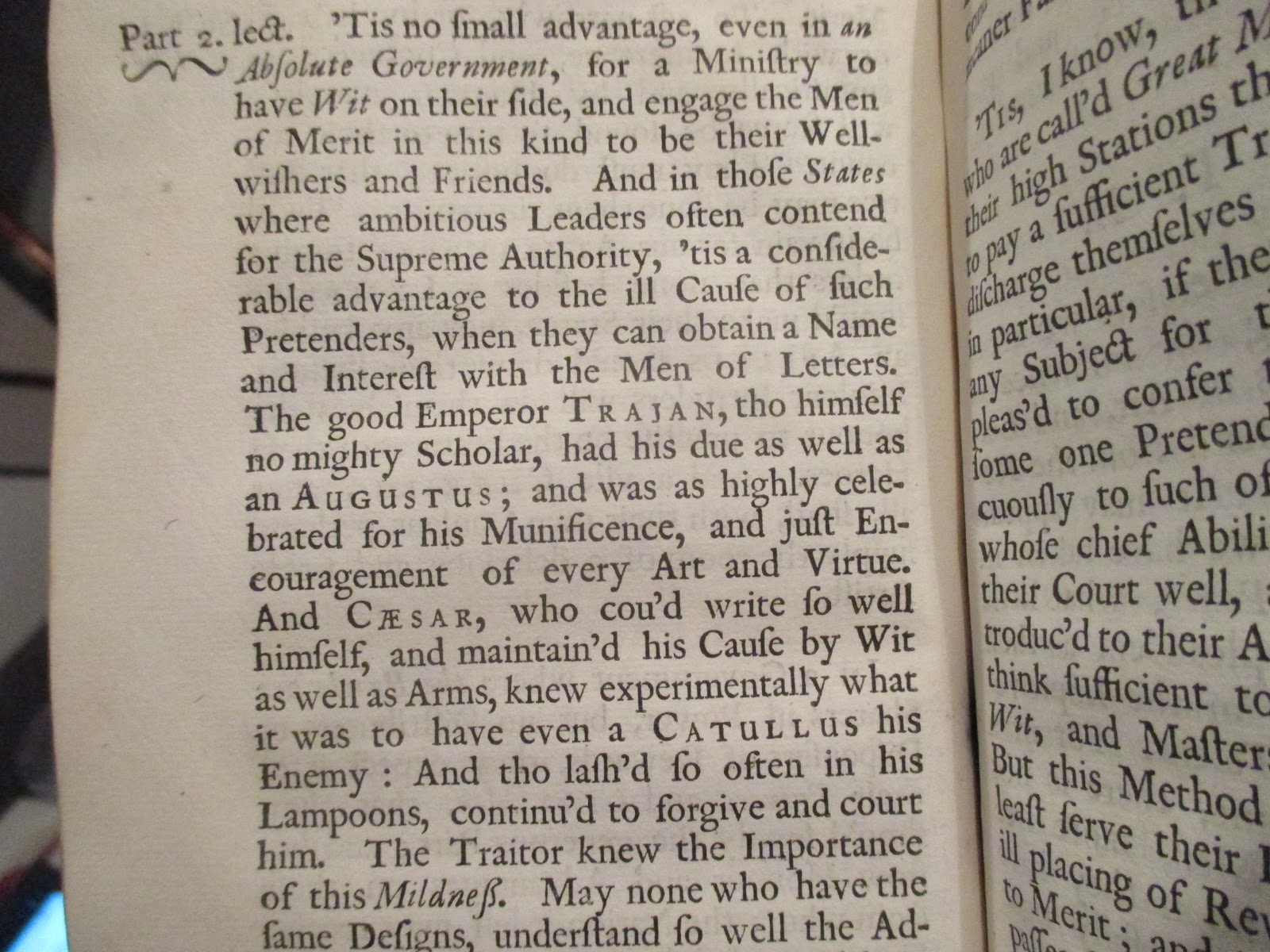
Which one? First of all, we can eliminate the first edition of 1711, as it did not yet include Gribelin’s plates (except for the medallion); and it contained generic woodcut ornaments that this edition lacks. Of the editions prior to 1743 that did contain Gribelin’s plates, we must choose between the 1714, 1723, 1727, 1732, and 1737-8 editions. Page 228 contains the smoking gun:

Vol. I, p. 228.
The sharp “s” (ß) in “Mildness” towards the bottom of the page occurs only in the 1711 and 1714 editions. In subsequent editions, it appears as a long “s” followed by a short one (ʃs). We can eliminate the 1711 edition, for reasons given above. We can also eliminate it for another reason: in the 1711 edition, the word carries over to the next line and is therefore hyphenated (“Mild-neß”). For additional evidence, look at the word “Absolute” near the top of the page. The “a” is upper-case; this occurs only in the 1711, 1714, and 1737 editions. But again, 1737 lacks the sharp “s”.

Therefore, by process of elimination, this “1743” edition is essentially the 1714 second edition, with a few pages containing missing plates recreated and inserted. These insertions are the only things entitling us to call this a “1743” edition. And the fact that the recreated plates are by John Brooks is the only thing entitling us to call this a “Dublin” edition. In all other respects, it’s not an “edition” at all: it is largely the 1714 London second edition.

All of this leads me to other questions for which I have no answers, such as:


  • How did a bunch of sheets of the 1714 edition, and missing precisely the same pages, end up in Dublin, to be re-issued after so many years?
  • Why did it call itself “the fourth edition”, an honour exclusive to the 1727 edition?
  • Were the second and third volumes ever published, or did publication cease after the first?

Wednesday, November 1, 2017

Addendum: English Editions of Shaftesbury

Back in November 2015 I wrote a post entitled “English Editions of Shaftesbury’s Characteristicks”. In it, I reviewed William E. Alderman’s 1967 paper of the same name, bringing his otherwise excellent list up to date, and adding a few other scraps of knowledge of my own on the subject. I am taking this opportunity to add something else that has just come to light.

Among other things, I had claimed that Baskerville’s (1773) “was the first edition since 1737 to reproduce all of Gribelin’s engravings.” In making this claim, I also had the authority of Alderman (p. 326). I have just discovered (on October 31, 2017) that the claim is not entirely correct. In fact, there was a 1743 edition that reproduced those original engravings (or very convincing reproductions – see below).

Furthermore, even more interesting is that this edition is missing from Alderman’s list. I do not know who the printer was, but above is a photo of the Volume I title page as it appeared in the Ebay listing where I came across it.

The listing is for Volume I only. Since it’s an odd volume, I cannot be sure that the other volumes bear the same date — or even that there are other volumes, since this one seems to be unique. Alderman did list a 1743-45 edition, but that was a duodecimo edition sans engravings. I have seen it, and it looks nothing like this. Tantalizingly, he also mentioned an apocryphal “Dublin 1743” edition once listed in a bookseller’s catalogue, which he did not include in his official list because he could not track down a specimen to examine (it had been sold).

In any case, according to the seller’s description, this is an octavo London edition, and from what I can tell at this point, its appearance bears this out: besides containing Gribelin’s engravings, it preserves the pagination of all the previous “official” London editions.

I have taken a gamble and ordered it. Once it arrives, I hope to be able to update this post with further information. In particular, I hope to confirm whether it is a London edition, and I hope to find out if there is any indication of a printer/publisher.

Up until 1732 the work was printed by John Darby. James Purser, who seems to have been successor to Darby’s business in Bartholomew Close, printed the 1737 edition. Was the 1743 edition also published by Purser? The latter was active into the 1740s, so it’s natural to assume so. However, confirming this may be difficult, since for each of the previous “official” editions of Characteristicks the publishing information appears only on the final page of the third volume, not in the first volume that is now on its way to me.

One thing that I should be able to confirm one way or the other is which edition appears on the main title page. The main title page of Purser’s 1737 publication described it as “The Sixth Edition”. Will the 1743 publication refer to itself as the 7th edition? Baskerville’s 1773 version (erroneously) advertised itself as the 5th edition. I have always held that the Baskerville is to be in some sense regarded as one of the “official” editions, for a few reasons:

  1. He somehow owned or had the sanction to use the original Gribelin plates.
  2. He did his best to restore the text and pagination as it had appeared in the earlier official editions from 1711 to 1737.
  3. He had the nerve to print “The Fifth Edition” on the title page, indicating that he regarded his new edition as something more than an act of piracy or clever imitation.
Of these facts, I believe the first is the most pertinent: the moral right to publication seems to have followed somehow the possession of the plates. Alderman points out that Baskerville’s claim to print the 5th edition was recognized as an error, for the errata sheet appearing in some copies — but not mine — corrects this to read “The Seventh Edition”, making it continuous with the 1737 Purser edition. This means that he regarded the 1733 edition and all others after 1737 to be unauthorized. What the “unofficial” 1733, 1743-45, 1749, 1757, and 1758 editions all lack are the Gribelin plates and the pagination corresponding to them.

If it turns out that the main title page of this 1743 edition says “The Sixth Edition”, then I would like to explore further whether it is simply a reissue of sheets from the 1737 edition with a new title page. If, on the other hand, it says “The Seventh Edition”, then this would be evidence that Baskerville — like Alderman — was unaware of its existence.

In any case, this 1743 edition, if it arrives as advertised and turns out to be an "official" edition, represents a small missing link in the rather large gap between 1737 and 1773, the period through which we must trace the hitherto mysterious route by which Baskerville acquired the Gribelin plates.
 

On the Other Hand… 

It may be that the plates are just very convincing knock-offs and that this is a hitherto unknown pirate edition. Despite the graininess of the above photo, I can already spot one difference from the Gribelin plates.

(HINT: It has to do with the location of Gribelin’s name on the volume plate above — assuming that name is even Gribelin’s, as I can't quite make it out. Similar problem with the plate pictured below.)


Also, the frontispiece portrait of Shaftesbury is not where one would expect to find it, which would be facing the main title page, not the volume title page.

Once my order arrives, I will be able to examine more closely the name on the plates. At the moment, despite the low resolution of the photos, it looks like it could be that of John Brooks, an engraver active in Dublin until 1747, when he moved to London. If that is the case, it would confirm my real suspicion, which is that the city of publication is not London, and that this is a specimen of Alderman’s fabled “Dublin 1743” edition.

Whatever the truth, it seems certain that this volume is unique. More to come…


Bibliography

ALDERMAN, William E. “English Editions of Shaftesbury’s CharacteristicsPapers of the Bibliographical Society of America 16.4 (1967), 315-334.

MEYER, H. E. “Correspondence: James Purser, Printer in Bartholomew Close, 1737,” The Library 27 (1972), p. 147.


Tuesday, August 1, 2017

The Language of Morals in “Mansfield Park”

In my previous post I referred to something I called an “aesthetic theory of morality”, which is often ascribed to moralists such as Shaftesbury. Broadly speaking, an aesthetic theory of morality attempts to equate or, otherwise link conceptually, the Good with the Beautiful.

There is more than one way that this may be done. For example, such a theory may claim that a good action is at the same time a beautiful action, or that our experience in beholding (or performing) a good act is relevantly similar in some way to our experience in beholding (or making) beautiful objects. Or a slightly different claim may be made, that only the sort of finely-tuned mind capable of properly apprehending beauty in objects is at the same time capable of properly apprehending moral good. Such a mind is motivated to act from a sense of appreciation of the beauty or “fittingness” (or in Latin, the decorum) of an action, and can appreciate the value of virtue in itself, independently of rewards and punishments. This view links moral judgment or moral character with aesthetic taste.

In the West in 2017, such a view might seem a bit strange. As judged by our high art, we are, after all, a culture peculiarly unmoved by artistic beauty. But in the 18th century, aesthetic theories of morality found wide acceptance, and not only in the rarefied circles of philosophy. One finds many of the novels of the 18th and early 19th centuries steeped in the ideas of the British moralists, and of these, it is the “aesthetic” moralists who seem to get most play.

I have this year been working through the novels of Jane Austen, a new and highly pleasurable experience for me. Of these novels, Mansfield Park (1814) has been the most interesting for my purposes. It is the one I believe to be most suffused with the language of the British moralists.
 

Although Austen was obviously well-read, she didn’t wear her learning on her sleeve. She was not a name-dropper. To discern influences, one must be able to hear their cadences in her works. When it comes to the British moralists, Mansfield Park makes for particularly happy hunting grounds for me in this respect.

The first thing I will say is that the British moralist with the most obvious influence on Austen by far, at least as gauged in terms of language, is Shaftesbury. This is not an original observation. The philosopher Gilbert Ryle noted it back in 1966 when he stated that

“Her stock of general terms in which she describes their minds and characters, their faults and excellences is, en bloc, Shaftesbury’s…. Her people have or lack moral sense, sense of duty, good sense, taste, good-breeding, self-command, spirits and good humour; they do or do not regulate their imaginations and discipline their tempers. Her people have or lack knowledge of their own hearts or their own dispositions; they are or are not properly acquainted with themselves; they do or do not practise self-examination and soliloquy. None of these general terms or idioms is, by itself, so far as I know, peculiar to Shaftesbury and herself. It is the amplitude of the stock of them, and the constant interplays of them which smack strongly of Shaftesbury.” (Ryle 299-300)

Ryle is mostly correct, though his actually understanding of Shaftesbury’s thought was superficial, to put it charitably (he referred to him as an Aristotelian, which is far from the case. Platonist or Stoic would be more apt). In any case, he summed up his paper thus: “I am primarily arguing for the general, if vague, conclusion that Jane Austen was, whether she knew it or not, a Shaftesburean. It is a dispensable sub-hypothesis that she had studied the rather tedious and high-flown writings of Shaftesbury himself…. But I shall put an edge on the issue by surmising, incidentally, that she did know” (Ryle 301).

Like Ryle, I am unable to demonstrate conclusively that Austen read Shaftesbury. And like Ryle, I am nevertheless convinced that she did. To the rather limited evidence that Ryle adduced, I should like to add some more of my own. Much of this evidence is linguistic, and drawn from the pages of Mansfield Park.

(N. B. Since different editions of Mansfield Park seem to vary not only in pagination, but also in chapter numbering, I have opted not to include citations with my quotations from that work. Instead, in the bibliography at the end of the post, the reader is directed to a searchable online text. Happy hunting.)
 

“Character” and “Manners”

The work by which Shaftesbury was mainly known was his collection of treatises published under the title of Characteristicks of Men, Manners, Opinions, Times (1711, 3 volumes). After so many readings I have become accustomed to the regular appearance of certain words in his writings. Indeed, two of them appear in the very title of his work: “manners” and “character” (and variants such as “characteristicks” and “characterize”). Being known as a philosopher of politeness (see Klein 1994), it is not surprising that “manners” occurs frequently in Shaftesbury’s Characteristicks, appearing 108 times, by my count. “Character” and variants appears there a staggering 298 times, almost always in a moral sense. Accounting for length of text, Austen’s use of “manners” in Mansfield Park is actually somewhat more frequent than Shaftesbury’s, with 52 occurrences. “Character”, in the moral sense only — not including, for example, theatrical or literary character — appears there 51 times. These are two Shaftesburean terms par excellence that are also extraordinarily prominent in Austen’s novel.
 

Impartiality and Disinterestedness

There is a cluster of semantically-related terms that appears with striking frequency in Mansfield Park: “impartial”, “disinterested”, “unbiased”, and variants. These occur at points where emotional distance is desirable in order to be able to make accurate moral and aesthetic judgments of people and things. The following are examples from Austen’s book (with key words and phrases in bold):

 “In the calmness of her [Lady Bertram’s] own dressing-room, in the impartial flow of her own meditations, unbiassed by his bewildering statements, she could not acknowledge any necessity for Fanny’s ever going near a father and mother who had done without her so long, while she was so useful to herself.”

“Her [Mary Crawford’s] acceptance must be as certain as his [Edmund’s] offer; and yet there were bad feelings still remaining which made the prospect of it most sorrowful to her, independently, she believed, independently of self.”

“For the purity of her intentions she could answer; and she was willing to hope, secondly, that her uncle’s displeasure was abating, and would abate farther as he considered the matter with more impartiality, and felt, as a good man must feel, how wretched, and how unpardonable, how hopeless, and how wicked it was to marry without affection.”

“Miss Crawford’s countenance, as Julia spoke, might have amused a disinterested observer.”
 

“Impartial” and its variants appears four times in Mansfield Park, and “disinterested” appears ten times. The last of the above quotes is of particular interest, since, rather than invoke Shaftesbury, the phrase “disinterested observer” might instead bring to mind Adam Smith, who in his Theory of Moral Sentiments (1759) made famous the figure of the “impartial spectator”:

“We endeavour to examine our own conduct as we imagine any other fair and impartial spectator would examine it. If, upon placing ourselves in his situation, we thoroughly enter into all the passions and motives which influenced it, we approve of it, by sympathy with the approbation of this supposed equitable judge. If otherwise, we enter into his disapprobation.” (Smith 110)

For Smith, the impartial spectator is a sort of ideal observer, who can accurately assess the moral terrain of a situation because his mind is unclouded by self-interested passions and affections. However, it is important to note that the impartial spectator is not an impassive figure; he feels things, and is capable of sentimental absorption in the Good and the Beautiful. Indeed, the reader of a novel is a sort of impartial spectator, insofar as she reacts emotionally to characters and situations despite having no personal interest in the outcome of the story. The key to the concept of the impartial spectator is not lack of emotion but lack of self-interest. Smith was drawing from his teacher Francis Hutcheson, who himself drew from Shaftesbury, in the realization that one’s emotional reactions may also be disinterested. In Austen’s words, quoted above, the impartial spectator “feels as a good man must feel”. Indeed, this was one of Henry Crawford’s central failings in Fanny Price’s eyes: “‘Will he not feel this?’ thought Fanny. ‘No, he can feel nothing as he ought.’”

Now, as I said, one might be tempted to see in Austen’s language of the impartial spectator the influence of Adam Smith. However, I believe it equally likely the influence is Shaftesbury’s, for the figure of the impartial spectator, if not the precise wording, is already present in his works, as in the following passage:

“The Mind, which is Spectator or Auditor of other Minds, cannot be without its Eye or Ear; so as to discern Proportion, distinguish Sound, and scan each Sentiment or Thought which comes before it. It can let nothing escape its Censure. It feels the Soft and Harsh, the Agreeable and Disagreeable, in the Affections; and finds a Foul and Fair, a Harmonious and a Dissonant, as really and truly here, as in any musical Numbers, or in the outward Forms or Representations of sensible Things.” (II.29)

Similarly, “impartial” and “disinterested” are terms Shaftesbury deployed fairly heavily, perhaps more so than did Smith. “Impartial” appears nine times in Characteristicks, including in such phrases as “impartial regard to merit” (I.226), “impartial censure of themselves” (I.277), and “impartial use of his reason” (I.36). “Disinterested” appears 17 times, in phrases such as “disinterested friendship” (I.101), “disinterested love of God” (II.271), “disinterested judges” (III.72), “a disinterested view” (III.221), and “disinterested authors” (III.242).

Soliloquy and Self-Examination

One of the individual treatises that comprise Shaftesbury’s Characteristicks is entitled “Soliloquy, or Advice to an Author”. In it, Shaftesbury recommends the practice of soliloquy, literally talking to oneself out loud, as a method of becoming a better writer, and indeed, a better person. The practice of such open and honest self-dialogue is a route to moral improvement. One gains self-understanding through allowing one’s inner voice to speak. Those who write or speak only for an audience, without stopping to listen to what they are saying, make for poor writers and shallow people. “Soliloquy” — the concept and the word — is prominent in Shaftesbury.

Interestingly, it is also appears at least three times in Mansfield Park. In two of these occurrences, the person doing the soliloquizing is Fanny Price, seemingly the only character consistently undeluded and capable of sound moral judgment:

“‘I must be a brute, indeed, if I can be really ungrateful!’ said she, in soliloquy. ‘Heaven defend me from being ungrateful!’”

“Such sensations, however, were too near akin to resentment to be long guiding Fanny’s soliloquies.”

Fanny’s moral core benefits from regular introspection; although others rarely listen to her, she certainly listens to herself. Henry Crawford, on the other hand, is the other soliloquizer, but he lacks the capacity for introspection and honesty. His soliloquy is a performance for public consumption, and as such, is not really soliloquy at all:

“Was not that well done of me? He brightened up directly. Now for my soliloquy.”

Crawford’s “soliloquy” comes in the context of preparing for an amateur theatrical, but I do believe Austen was trying to create a contrast between his character and Fanny’s. Acting in a play is probably Crawford’s only occasion for soliloquy, and he is only play-acting at it.

Another conspicuous feature of Jane Austen’s language in Mansfield Park is its heavy use of “self” words. These are words that have “self-” as a prefix and are almost invariably used to express some reflexive act of examination, regulation, evaluation, or other moral attitude towards the self. As with “soliloquy”, the use of these terms implies introspection, and a capacity for moral self-regulation. Below is a list of these words and their frequency in Austen’s novel:

          Self-command (3)
          Self-denial (3)
          Self-reproach (2)
          Self-deceit (2)
          Self-denying (2)
          Self-willed (2)
          Self-consequence (2)
          Self-knowledge
          Self-condemnation
          Self-inquiry
          Self-distrust
          Self-respect
          Self-government
          Self-conceit
          Self-engrossed
          Self-possession

I believe that this (over)use of “self” words is, again, an indicator of Shaftesbury’s influence on Austen, for it is also a very prominent usage in Characteristicks, occurring there 128 times (not counting examples such as “self-same”, which merely express identity). Indeed, two such words appearing in Shaftesbury’s writings — “self-disparagement” and “self-governed” — pre-date the OED’s earliest citation (Hall 252). This reflexive moral language is to be expected in an author who recommends soliloquy as a method of moral self-governance. She who talks to herself, better governs herself, as Austen’s Fanny Price demonstrates.

Rhapsody and Rhapsodizing

Another of the individual treatises included in Shaftesbury’s Characteristicks is one called “The Moralists, a Philosophical Rhapsody”. It is an extended philosophical dialogue related in a letter from Philocles to his friend Palemon. The main characters of the dialogue are Philocles and Theocles. Without getting into too much detail, Philocles is a sceptic who is gradually brought round to a more positive philosophical viewpoint by the wiser Theocles.

Much of Theocles’ moral and philosophical doctrine is conveyed in the form of rhapsody, long ecstatic raptures on the beauty of nature and the order and harmony of the universe. He gets carried away with enthusiasm and finds a willing audience in Philocles. The following is a truncated example of one of Theocles’ rhapsodies:

“Just as I had said this, he [Theocles] turn’d away his Eyes from me, musing a-while by himself: and soon afterwards, stretching out his Hand, as pointing to the Objects round him, he began.
     ‘Ye Fields and Woods, my Refuge from the toilsome World of Meditation. Business, receive me in your quiet Sanctuarys, and favour my Retreat and thoughtful Solitude. — Ye verdant Plains, how gladly I salute ye! — Hail all ye blissful Mansions! Known Seats! Delightful Prospects! Majestick Beautys of this Earth, and all ye Rural Powers and Graces! — Bless’d be ye chaste Abodes of happiest Mortals, who here in peaceful Innocence enjoy a Life un-envy’d, tho Divine; whilst with its bless’d Tranquillity it affords a happy Leisure and Retreat for Man; who, made for Contemplation, and to search his own and other Natures, may here best meditate the Cause of Things; and plac’d amidst the various Scenes of Nature, may nearer view her Works.
     ‘O glorious Nature! supremely Fair, and sovereignly Good! All loving and All-lovely, All-divine! Whose Looks are so becoming, and of such infinite Grace; whose Study brings such Wisdom, and whose Contemplation such Delight; whose every single Work affords an ampler Scene, and is a nobler Spectacle than all which ever Art presented! — O mighty Nature! Wise Substitute of Providence! Impower’d Creatress! Or Thou impowering DEITY, supreme Creator! Thee I invoke, and Thee alone adore. To thee this Solitude, this Place, these Rural Meditations are sacred; whilst thus inspir’d with Harmony of Thought, tho unconfin’d by Words, and in loose Numbers, I sing of Nature’s Order in created Beings, and celebrate the Beautys which resolve in Thee, the Source and Principle of all Beauty and Perfection.’” (II.344-345)


This is just an excerpt; it goes on (and on). I find this style rather tedious, and it was not universally admired in Shaftesbury’s own day. Indeed, Pope satirized the above-quoted passage in The Dunciad. Nevertheless, it had its fans, and I suspect that Jane Austen was one of them. Compare the cadences of Theocles’ rhapsody with Fanny Price’s:

“Fanny spoke her feelings. ‘Here’s harmony!’ said she; ‘here’s repose! Here’s what may leave all painting and all music behind, and what poetry only can attempt to describe! Here’s what may tranquillise every care, and lift the heart to rapture! When I look out on such a night as this, I feel as if there could be neither wickedness nor sorrow in the world; and there certainly would be less of both if the sublimity of Nature were more attended to, and people were carried more out of themselves by contemplating such a scene.’
     ‘I like to hear your enthusiasm, Fanny. It is a lovely night, and they are much to be pitied who have not been taught to feel, in some degree, as you do; who have not, at least, been given a taste for Nature in early life. They lose a great deal.’
     ‘You taught me to think and feel on the subject, cousin.’”


The capacity for appreciating the beauty and order of nature is a virtue in itself in both Shaftesbury and in Mansfield Park, and it is the source — or at least the token — of all the other virtues. Characters who cannot, Theocles-like, be moved to rhapsody by nature tend also to be lacking in other moral qualities. Rhapsody forms a basis of contrast between Fanny Price and Mary Crawford in the following passage:

“‘I am so glad to see the evergreens thrive!’ said Fanny, in reply. ‘My uncle’s gardener always says the soil here is better than his own, and so it appears from the growth of the laurels and evergreens in general. The evergreen! How beautiful, how welcome, how wonderful the evergreen! When one thinks of it, how astonishing a variety of nature! In some countries we know the tree that sheds its leaf is the variety, but that does not make it less amazing that the same soil and the same sun should nurture plants differing in the first rule and law of their existence. You will think me rhapsodising; but when I am out of doors, especially when I am sitting out of doors, I am very apt to get into this sort of wondering strain. One cannot fix one’s eyes on the commonest natural production without finding food for a rambling fancy.’
     ‘To say the truth,’ replied Miss Crawford, ‘I am something like the famous Doge at the court of Lewis XIV.; and may declare that I see no wonder in this shrubbery equal to seeing myself in it. If anybody had told me a year ago that this place would be my home, that I should be spending month after month here, as I have done, I certainly should not have believed them. I have now been here nearly five months; and, moreover, the quietest five months I ever passed.’”


Mary Crawford is unable to lose herself in nature because she is already lost to herself. She, like her brother, is the type of person who requires the noise and distraction of the city. Quietude only brings her disquiet.

The subject of rhapsody points to an interesting tension throughout the novel: On the one hand, the ideal moral agent is expected to feel, and to participate in nature and in the feelings of others. On the other hand, the ideal moral agent is also expected to be “impartial”, “unbiased”, “disinterested” and, like Fanny Price, something of a spectator. Austen “pits the absorption that marks the picturesque views against the detachment, distance, and impartiality her third-person narrative suggests constitute the proper standard of reflection” (Valihora 278). There is often a struggle in Fanny over the extent to which she can permit herself to participate in the drama of those around her. Like Adam Smith’s impartial spectator, she feels for those around her, but not to the same extent they feel for themselves.

The moral theory espoused by Austen in Mansfield Park is an aesthetic one. Virtue requires a capacity to appreciate and participate in beauty. The Good and the Beautiful are inextricably linked through concepts such as harmony, elegance, and proportion:

“The elegance, propriety, regularity, harmony, and perhaps, above all, the peace and tranquillity of Mansfield, were brought to her remembrance every hour of the day, by the prevalence of everything opposite to them here.”

And a person of good character is also a person of taste and finer sentiments:

“It was a picture which Henry Crawford had moral taste enough to value. Fanny’s attractions increased — increased twofold; for the sensibility which beautified her complexion and illumined her countenance was an attraction in itself. He was no longer in doubt of the capabilities of her heart. She had feeling, genuine feeling.”

I hope to have shown more thoroughly than Ryle did that the language of morals in Mansfield Park is largely the language of Shaftesbury.

Bibliography

AUSTEN, Jane. Mansfield Park.

HALL, Roland. “Shaftesbury: Some Antedatings and New Words,” Notes and Queries 206 (1961), 251-253.

KLEIN, Lawrence E. Shaftesbury and the Culture of Politeness: Moral Discourse and Cultural Politics in Early Eighteenth-Century England. Cambridge: Cambridge University Press, 1994.

RYLE, Gilbert. “Jane Austen and the Moralists,” in Collected Papers (Vol. I). London: Routledge, 2009.

SHAFTESBURY, Anthony Ashley Cooper, 3rd Earl of. Characteristicks of Men, Manners, Opinions, Times (3 vols.). London, 1711 (facsimile, Hildesheim: Georg Olms, 1978).

SMITH, Adam. The Theory of Moral Sentiments. D. D. Raphael and A. L. Macfie (eds.). Oxford: Clarendon Press, 1979.

VALIHORA, Karen. Austen’s Oughts: Moral Judgment after Locke and Shaftesbury. Newark, DE: University of Delaware Press, 2010.