A great conservative thinker (Burke) once said of another, “Who now reads Bolingbroke? Who ever read him through?” For context, Burke was referring specifically to Lord Bolingbroke’s posthumous philosophical writings, which, it is true, are not much read or indeed worth reading. But his political writings are another matter, which I perhaps shall expand upon in some future post.
I would apply Burke’s assessment of Bolingbroke’s reputation to another great conservative thinker, though perhaps with more justification: Who now reads Filmer? Who ever read him through?
Sir Robert Filmer (1588-1653) is best known today, if known at all, as the author whom John Locke attacked in his Two Treatises of Government (1689) for his supposedly crackpot views on the divine right of Kings having been derived from Adam through the Old Testament patriarchs. I was forced to read Locke’s Two Treatises in university, but I was never made to read Filmer. Had I done so, I would have discovered that the latter serves as a straw man for the former. My Whiggish educators would not have allowed that to happen, especially had any of them read Filmer themselves, which I suspect they hadn’t. So inconsequential is Filmer considered, that he doesn’t warrant an entry in the Stanford Encyclopedia of Philosophy.
Philosophical reputation can be a faddish thing. It is very much subject to the pressing concerns and fickle fancies of each generation of philosophers. There was a time when David Hume was considered to be a historian. If recognized at all as a philosopher, it was as one that was bad, mad, and dangerous to know. At the same time, Thomas Reid was considered to be a philosopher’s philosopher who spawned an extremely influential school (Scottish Common Sense philosophy). There was at that time no “Humean School” to speak of. As the English-speaking world became more skeptical, less deferential to authority, more inclined to scoff at moral and religious claims to truth, more immoral (or at least amoral), Hume’s star rose and Reid’s fell. And yet, for we happy few who have taken the time to read and engage with Reid’s thought, we might wonder whence this neglect of Hume’s great contemporary.
Sometimes philosophy may hold an unflattering mirror up to society. But more often, society simply chooses the philosophical mirror it prefers to see itself reflected in. In modern times we have tended to choose very Whiggish mirrors.
Those who know of Sir Robert Filmer at all typically know him exclusively at second hand, through the critiques of John Locke and perhaps Algernon Sidney. Reliance on these sources gives a mistaken impression of him. For one thing, these critiques rely heavily on one work of Filmer’s, Patriarcha, published posthumously in 1680. By then, Filmer had been dead for nearly 30 years, and in any case, Patriarcha was not the work he was best-known for in his lifetime, not the work upon which his earlier reputation was built. For that, one must turn to such works as The Free-holders Grand Inquest (1648), The Anarchy of a Mixed or Limited Monarchy (1648), or Observations concerning the Originall of Government (1652). It must be admitted however, that much in these works was borrowed from Patriarcha. And it must also be admitted that since the 1980s there has arisen some controversy as to whether Filmer was actually the author of The Free-holders Grand Inquest. (If he didn’t write it, then the anonymous author was someone who thought, wrote, and argued very much like him.)
Given the lapse of time between Filmer’s death and the critiques of Locke and Sidney, it should be noted that the latter were writing to a different generation, with different political concerns. While Filmer wrote in the context of the English Civil War, Sidney’s Discourses concerning Government (also published posthumously) was written during the Exclusion Crisis, as part of a campaign to keep the Catholic James, Duke of York from succeeding his brother on the English throne. Locke’s Two Treatises (1689) was published during the so-called “Glorious Revolution” that replaced James II (the aforementioned Catholic Duke of York) with his daughter Mary and her Dutch husband William III. Actually, Locke’s work was written earlier, during the Exclusion Crisis. As Peter Laslett, Locke’s greatest editor, convincingly argued, “Two Treatises is an Exclusion Tract, not a Revolution Pamphlet” (p. 61). In any case, whether these were Exclusion or Revolution tracts, they were trying roughly to achieve the same thing: delegitimize the (hereditary) Stuart claim to the throne by attacking a prominent defender of it.
Filmer is portrayed by Locke and Sidney as rather a ridiculous figure, a slightly cretinous old reactionary with crack-brained ideas about the King being God’s anointed through descent from Adam. That portrayal has essenitally continued to this day. In a review of a then-new edition of Filmer’s works, Christopher Hill, eminent 20th-century Marxist historian of the English Civil War period, cannot help making a snide little jab at Filmer (and Tories in general) when he wrote that “Filmer’s theory was the best the Tories could produce in the decisive decade 1678-88.” Again, it seems we’re meant to save ourselves the trouble of reading something not worth reading.
Hill’s words paper over the fact that through that same decade the Whigs hadn’t fared much better; they too stooped to grave-digging, resurrecting long-dead authors to support their cause. Philip Hunton’s A Treatise of Monarchy (1643) comes to mind, which was reprinted in 1689, not long after Filmer’s works had been reissued. Entering this pair in the lists was ironic, for they had done battle previously: Hunton’s Treatise had already been ably answered by Filmer’s Anarchy years before. It seems both sides were scavenging old ideas to support their respective causes, as is attested by the outpouring of reprints of Civil War-era works on similar themes that were reprinted during the Exclusion Crisis and the "Glorious" Revolution (a large selection of which can be found scattered in the pages of the Harleian Miscellany, for those who are interested).
If Filmer was as obtuse and not worth reading as Locke, Sidney, Tyrrell, et al. have portrayed him (and as Christopher Hill implies), then why did they put themselves to the trouble of reviving and then attacking him? Why not let the poor deluded old man rest in peace? One reason was that the Tories had reprinted his previously published works in 1679, followed by an edition of his previously unpublished Patriarcha in 1680. The other reason was that Filmer’s ideas had proponents, influential ones. As Locke tells us in his preface,
“There was never so much glib Nonsence put together in well sounding English. If he [the reader] think it not worth while to examine his Works through, let him make an Experiment in that Part where he treats of Usurpation, and let him try whether he can, with all his Skill, make Sir Robert intelligible…. I should not speak so plainly of a Gentleman, long since past answering, had not the Pulpit, of late years, publickly owned his Doctrine, and made it the Currant Divinity of the Times.”
Thomas Hobbes had also strenuously defended monarchy, though on different grounds than Filmer. However, Hobbes was also a notorious infidel, and could therefore be safely ignored by most in the 1680s. Indeed, some of his ideas – e.g. natural liberty in an original state of nature, the institution of government by contractual consent – had already been co-opted by the Whigs for their purposes, so that by a strange sublimation, what had been arguments for absolutism became the very core of liberal theory.
Unlike Hobbes, Filmer was no outsider; he was a member of the landed gentry and he was an orthodox religionist who went out of his way to attack the infidel Hobbes. He was therefore taken up by clergymen in a way that Hobbes could not be. So every Sunday from pulpits across the land, the laity were being instructed by High Church preachers in the virtues of passive obedience to a monarchy instituted and sanctioned by God.
Reading between the lines, one gets the impression that the Whigs felt they were losing the battle for hearts and minds. I suspect they were. But you’d never know it from the Whiggish triumphalism suffusing modern accounts of the Locke-Filmer debate. When I read Locke’s Two Treatises, I sense that the author’s seeming contempt is masking palpable ideological fear.
I contend that Locke and Sidney misunderstand (willfully?) Filmer’s point. Filmer wasn’t claiming that Charles I literally derived his power from the biblical patriarchs. He was merely making the point that political obligation, specifically obligation to a monarch, was a basic anthropological phenomenon that pre-existed any supposed compact or agreement among the political community. Subjection to authority is and has always been a natural state, into which each of us is born; it is most commonly found in the subjection of child to parent, and forms our earliest “political” experience. (Note too, that unlike the Whiggish view of political subjection, this natural relationship is not based solely – or even mostly – on an implicit threat of violence.) The supposed Hobbesian/Lockean “natural freedom” in a state of nature, on the other hand, is mere fiction. Hence, writes Filmer, “Where subjection of children to parents is natural, there can be no natural freedom” (The Anarchy, p. 142). We do not spring up like mushrooms in the night, as fully-formed isomorphic liberal selves.
Now this claim, that political authority is conceptually or analogously related to parental authority, is one that might be argued against on historical/factual grounds, but it is not an absurd or lunatic claim. The fact is, we each of us is born under authority, and we rarely question its legitimacy. So why are we so quick to question the legitimacy of existing political authority, especially in the form of a monarchy which had existed since time immemorial? Why the need to replace this common experience with an abstract and likely fictional account of an original social contract? It is ironic that, while Filmer was attacking the theorizing of Hobbes and others, who based political obligation upon a supposed social contract, Locke attempts to refute Filmer by offering — a social contract theory!
Filmer was not alone in criticizing as a whimsical fiction this social contract view of the origins of political obedience. One of Locke’s antagonists, the underrated Edward Stillingfleet (1635-1699), Bishop of Worcester, made a similar point, writing “Every new modeller of government hath something to offer that looks like reason, at least to those whose interest it is to carry it on: and, if no precedents can be found, then they appeal to a certain invisible thing called, The Fundamental Contract of the Nation, which, being no where to be found, may signify what any one pleaseth” (quoted in Hatsell, Vol. II, p. 72).
As already noted, it was in part the later preaching of Filmerian doctrine from the pulpits by clergyman such as Stillingfleet that spurred Locke to write his Two Treatises. But contrary to prevailing prejudices, it was not just clergyman and High Church Tories who were skeptical of Whiggish social contract doctrines. Chief Justice Matthew Hale (1609-1676), no High Church clergyman, and someone respected by Whig and Tory alike, wrote of England that “the original pact whereby this kingdom was settled appears not, neither have we reason to believe there was any extant, it having been so ancient a kingdom… and therefore should we make our estimate of the nature and extent of the government by that, we should be at a loss” (p. 8). So at least some of Filmer’s doctrines were establishment rather than fringe ideas, contrary to how Filmer’s legacy is portrayed by today’s Whiggish scholars.
I implied above that Locke and Sidney willingly misunderstood Filmer. First, as mentioned, they mostly chose to criticize one work, the posthumous Patriarcha. Secondly, they chose to overemphasize and mischaracterize the notion that the monarch’s authority is an estate handed down from the biblical patriarchs, who derived it from Adam. The edition of Patriarcha I have is 64 pages long. Only one part of the first chapter, a passage totaling about 9 pages, contains what is commonly supposed to be his central tenet, that monarchy is derived from the paternal authority of the Old Testament patriarchs and ultimately from Adam. There is as much Roman as there is Old Testament history in the work, and there is more English constitutional history than either (roughly 20 pages).
Indeed, Filmer demonstrates a much deeper knowledge of English constitutional history and precedent than either Sidney or Locke. In this regard, I find Locke in particular appallingly ignorant of the constitutional law and customs of his own country. This is not atypical of philosophers, who rarely let facts stand in the way of a good theory. Stillingfleet’s words, quoted above, are instructive here: Locke is one of those “new modellers” of government who, lacking precedents (largely due to his legal-constitutional ignorance), appeals to a fictional contract, which serves as the black box for whatever preconceived theory he wishes to pull out of it. There is a grain of truth to this claim, for it certainly is interesting that different social contract theorists manage to generate vastly different ideal political systems from the same basic theoretical machinery. Locke’s ideal commonwealth is radically different from Hobbes’, Hobbes’ is radically different from Rousseau’s, and Rawls’ is vastly different from Nozick’s. What all of them do have in common is a readiness to make vast quasi-anthropological claims on pretty thin empirical grounds (though to be fair, Filmer is guilty of this too).
In his use of constitutional history and precedent, Filmer has been accused of unoriginality, relying heavily on other sources. If so, then it merely shows that better minds than his were already thinking along the same lines about monarchy, sovereignty, and political authority. For example, one of Filmer’s sources was the antiquarian Sir Robert Cotton (1571-1631). In a short and accessible posthumous work, The Antiquity and Dignity of Parliaments (again, one of those earlier unpublished works that was dug up and published in 1679), Cotton presents a comprehensive range of precedents, in chronological order. They are all marshalled to show very convincingly that the inclusion of the commons in Parliament was a relatively recent development, and that Parliament was always intended to be no more than an advisory body to the King, summoned and dissolved at his pleasure. The King was placed in a position above the law, his sovereignty undivided. This is essentially Filmer’s view of the matter, and The Free-holders Grand Inquest could have been written by Cotton.
The cartoonish Whig depiction of Filmer, as a crazed or semi-retarded old religious zealot, whose defense of his King relies mostly or solely on Old Testament patriarchy, goes back a lot further than Locke and Sidney. Just a few years after Filmer’s death, we find Marchamont Nedham writing that “Those Men that deny this Position [that the origin of legitimate government rests with the people], are fain to run up as high as Noah and Adam, to gain a pretence for their Opinion: alledging, That the primitive or first Governments of the World were not instituted by the consent and election of those that were governed” (The Excellencie of a Free-State (1656), p. 70). Nedham was writing before Patriarcha was published. His editor, Blair Worden, believes that the reference is to Filmer’s The Anarchy of a Limited or Mixed Monarchy (1648). Assuming so, then just as with Filmer’s Whig critics a quarter of a century later, Nedham’s characterization of his argument’s reliance on Old Testament patriarchy is absurdly overblown. The edition of The Anarchy I have in my hand is forty pages long. Of that, passages reliant on biblical history, taken together, account for roughly two pages. Classical and contemporary references vastly outnumber scriptural ones. Indeed, if Filmer’s Anarchy was so reliant on Scripture, one would expect him to have chosen a verse or two of Scripture for his epigraph. Instead, he chose a couple of lines from Lucan’s Pharsalia.
Nedham seems to have been a man of rather flexible political convictions; he held them strongly and eloquently, but only until it was no longer in his interest to hold them. He wrote The Excellencie of a Free-State during his second period as a Commonwealthsman, after a stint as a Royalist propagandist. In it he argued that the end of government being the good of the people, the people ought to govern themselves, because “they best know where the shooe pinches” (p. 25). Therefore, he advocated a unicameral government by a representative popular assembly. As a conservative, someone like me might wonder whether Nedham’s claim is strictly true. Do the people always best know where the shoe pinches? And are they necessarily best placed to know how to what's causing it and how to fix it? After all, not every wearer of a shoe is a shoemaker.
It is a perennial theme of conservative jeremiads that “the people” (or “the mob”) are fickle and turbulent. Hence the need for a form of energetic government with a strongly concentrated sovereignty. For many centuries monarchy was that form of government. It is perhaps hard for us now to understand the monarchist mindset, and we are surprised when we see atavistic manifestations of it in the form of broad popular support for a Putin, a Duterte, or a Trump. But most of the people who have ever existed, have lived and died under the rule of monarchs. With this in mind, we might be a little more charitable when approaching thinkers such as Filmer, for whom monarchy was natural in the strongest sense.
Bibliography
COTTON, Sir Robert. The Antiquity and Dignity of Parliaments (1679). Reprinted in The Harleian Miscellany, Vol. VIII, pp. 216-228. London: Robert Dutton, 1810.
FILMER, Sir Robert. Patriarcha and Other Writings. Johann P. Sommerville (ed.). Cambridge: Cambridge University Press, 1996.
HALE, Sir Matthew. The Prerogatives of the King. D. E. C. Yale (ed.). London: Selden Society, 1976.
HATSELL, John. Precedents of Proceedings in the House of Commons (4 vols.). London: Luke Hansard, 1818.
HILL, Christopher. Review of Patriarcha and Other Political Works of Sir Robert Filmer (Laslett, ed.). History 37.130 (1952), 166.
HUNTON, Philip. A Treatise of Monarchy. Reprinted in The Harleian Miscellany, Vol. IX, pp. 321-371. London: Robert Dutton, 1810.
LOCKE, John. Two Treatises of Government. Peter Laslett (ed.). Cambridge: Cambridge University Press, 1988.
NEDHAM, Marchamont. The Excellencie of a Free-State. Blair Worden (ed.). Indianapolis: Liberty Fund, 2011.
SIDNEY, Algernon. Discourses concerning Government. Thomas G. West (ed.). Indianapolis: Liberty Fund, 1996.
TYRELL, James. Patriarcha non Monarcha: The Patriarch Unmonarch’d. London: Richard Janeway, 1681.
Showing posts with label Politics. Show all posts
Friday, March 15, 2019
Tuesday, August 7, 2018
The New Family Compact
In 1837, in what is now Ontario but was then called “Upper Canada”, there was a rebellion. The rebels were fighting for the cause of representative government in a province which, at the time, was largely ruled by a relatively small clique of Tory landholders called the “Family Compact”. The extent to which members of this compact were related to each other has perhaps been exaggerated, but they were certainly socially tight-knit, forming a quite exclusive ruling class.
The Whiggish interpretation of this history we learned in school was that although the rebellion was quickly put down, the cause for which the rebels fought eventually triumphed. It’s a comforting notion, but I’ve noticed of late that if it were ever true, it is becoming ever less so now. I was reminded of this by a bit of recent news.
According to a July 18, 2018 Toronto Star column, Blayne Lastman, the son of vulgar furniture salesman and former Toronto Mayor Mel Lastman, was considering a run for his father’s old job (I should qualify by saying that Blayne is Mel’s legitimate son). As the Star columnist rightly noted, “Why else but the sheer fact of his surname does a guy like Blayne Lastman feel comfortable declaring an interest in running for mayor without first presenting to the public a single coherent idea about how he will make the city a better place?” Blayne Lastman’s qualifications for office consist exclusively of a) running his family’s furniture store, and b) being the (legitimate) son of a former mayor.
The last thing Torontonians, Ontarians, and Canadians need is another family dynasty. Our current family compact makes the old one seem quaint by comparison. Below is a sample of the familial rot in all three levels of government here in “Toronto the Good”. It is by no means an exhaustive list and could be significantly extended. It makes for sobering reading and goes far towards explaining the poor quality of governance in this city, this province, and indeed this nation. One wonders whether representative government really did triumph after 1837, or whether perhaps it is once again time for torches and pitchforks.
City of Toronto
Michael Ford: Current Toronto councillor; nephew of Doug Ford, current Premier of Ontario and former Toronto councillor. Nephew of Rob Ford, former councillor and infamous crack-smoking Mayor of Toronto.
Josh Colle: Current Toronto councillor; son of former Ontario MPP Mike Colle.
Joe Cressy: Current Toronto councillor; son of former Toronto councillors Gordon Cressy and Joanne Campbell. Joanne had been Gordon’s executive assistant while he was on council, and was elected to his seat after he stepped down. She subsequently married him. Oh, if only the walls of some of those City Hall offices could talk, what tales they could tell…
Mike Layton: Current Toronto councillor; son of Jack Layton, former Toronto councillor, former federal MP, and Leader of the Opposition. Jack was himself the son of former federal MP and cabinet minister Bob Layton. Mike's stepmother is also a former Toronto councillor.
Stephen Holyday: Current Toronto councillor; son of Doug Holyday, former Toronto councillor.
Frances Nunziata: Current Toronto councillor; sister of former federal MP John Nunziata.
Michelle Holland: Current Toronto councillor; wife of former Toronto councillor and Ontario MPP Lorenzo Berardinetti.
Christin Carmichael Greb: Current Toronto councillor; daughter of former federal MP John Carmichael.
David Shiner: Current Toronto councillor; son of former North York borough councillor Esther Shiner.
Mike McCormack: Current head of Toronto’s police union; son of former Toronto chief of police William McCormack. He has been the subject of several criminal charges during his career, including corruption, discreditable conduct, and insubordination. Untouchable criminal thug.
Province of Ontario
Doug Ford: Current Premier of Ontario and former Toronto councillor; uncle of current Toronto councillor Michael Ford; son of former Ontario MPP Doug Ford Sr.; brother of Rob Ford (see above, under Michael Ford).
Christine Elliott: Current Ontario MPP and cabinet minister; widow of Jim Flaherty, former Ontario MPP and cabinet minister and former federal Minister of Finance.
Caroline Mulroney: Current Ontario MPP and cabinet minister; daughter of former Canadian Prime Minister Brian Mulroney.
Mike Harris Jr.: Current Ontario MPP; son of former Premier of Ontario Mike Harris.
Government of Canada
Justin Trudeau: Current Prime Minister of Canada; son of Pierre Trudeau, former Prime Minister of Canada.
Niki Ashton: Current federal MP; daughter of Manitoba provincial cabinet minister Steve Ashton.
Daniel Blaikie: Current federal MP; son of former federal MP Bill Blaikie. Serves in his father’s former riding.
Tony Clement: Current federal MP and former cabinet minister; adopted son of former Ontario MPP and cabinet minister John Clement.
Diane Finley: Current federal MP; widow of political operative and former Senator Doug Finley.
David McGuinty: Current federal MP; brother of former Premier of Ontario Dalton McGuinty; son of former Ontario MPP Dalton McGuinty Sr.
Geoff Regan: Current federal MP and Speaker of the House of Commons; son of former Nova Scotia Premier and accused sex offender Gerald Regan. His maternal grandfather was a federal MP.
Francesco Sorbara: Current federal MP; relative of Greg Sorbara, former Ontario MPP and Minister of Finance. In Ontario, the extended Sorbara clan are a “family” in much the same sense that the Sopranos or the Gambinos are families. I could tell stories, but it’s safest not to.
Adam Vaughan: Current federal MP and former Toronto councillor; son of Colin Vaughan, also a former Toronto councillor. It’s also worth noting that Adam succeeded his father as political reporter for a certain local television station back in 2000. A very famous mediocrity in Toronto politics.
UPDATE: Municipal elections were held on October 23, 2018, after the above was posted. First, the good news: Shiner, Holland, Colle, and Greb are out. Unfortunately, Colle was replaced by his father, Mike Colle. Now, the bad news: Due to the fact that for this election, the number of wards was reduced from 47 to 25, the proportion of Toronto council seats held by the family compact has increased, from 19.15% to 24%. Several incumbents were replaced by other incumbents, as the circle closed. In Vancouver, Pete Fry was elected to a seat on Vancouver's city council. Pete's mother is Vancouver-area federal MP and race-baiter Hedy Fry. Fry mater is currently the longest serving MP in the House of Commons, having been first elected in 1993 (term limits anyone?). Oh, and history was also made in this set of municipal elections, as it was the first time that a married couple were both elected as trustees for the Toronto District School Board - quite a feat, as they were elected in different wards. Since they live together, might one assume that perhaps the ward boundary runs right down the centre of the marital bed? In any case, another triumphant day for democracy in Canada.
The Whiggish interpretation of this history we learned in school was that although the rebellion was quickly put down, the cause for which the rebels fought eventually triumphed. It’s a comforting notion, but I’ve noticed of late that if it were ever true, it is becoming ever less so now. I was reminded of this by a bit of recent news.
According to a July 18, 2018 Toronto Star column, Blayne Lastman, the son of vulgar furniture salesman and former Toronto Mayor Mel Lastman, was considering a run for his father’s old job (I should qualify by saying that Blayne is Mel’s legitimate son). As the Star columnist rightly noted, “Why else but the sheer fact of his surname does a guy like Blayne Lastman feel comfortable declaring an interest in running for mayor without first presenting to the public a single coherent idea about how he will make the city a better place?” Blayne Lastman’s qualifications for office consist exclusively of a) running his family’s furniture store, and b) being the (legitimate) son of a former mayor.
The last thing Torontonians, Ontarians, and Canadians need is another family dynasty. Our current family compact makes the old one seem quaint by comparison. Below is a sample of the familial rot in all three levels of government here in “Toronto the Good”. It is by no means an exhaustive list and could be significantly extended. It makes for sobering reading and goes far towards explaining the poor quality of governance in this city, this province, and indeed this nation. One wonders whether representative government really did triumph after 1837, or whether perhaps it is once again time for torches and pitchforks.
City of Toronto
Michael Ford: Current Toronto councillor; nephew of Doug Ford, current Premier of Ontario and former Toronto councillor. Nephew of Rob Ford, former councillor and infamous crack-smoking Mayor of Toronto.
Josh Colle: Current Toronto councillor; son of former Ontario MPP Mike Colle.
Joe Cressy: Current Toronto councillor; son of former Toronto councillors Gordon Cressy and Joanne Campbell. Joanne had been Gordon’s executive assistant while he was on council, and was elected to his seat after he stepped down. She subsequently married him. Oh, if only the walls of some of those City Hall offices could talk, what tales they could tell…
Mike Layton: Current Toronto councillor; son of Jack Layton, former Toronto councillor, former federal MP, and Leader of the Opposition. Jack was himself the son of former federal MP and cabinet minister Bob Layton. Mike's stepmother is also a former Toronto councillor.
Stephen Holyday: Current Toronto councillor; son of Doug Holyday, former Toronto councillor.
Frances Nunziata: Current Toronto councillor; sister of former federal MP John Nunziata.
Michelle Holland: Current Toronto councillor; wife of former Toronto councillor and Ontario MPP Lorenzo Berardinetti.
Christin Carmichael Greb: Current Toronto councillor; daughter of former federal MP John Carmichael.
David Shiner: Current Toronto councillor; son of former North York borough councillor Esther Shiner.
Mike McCormack: Current head of Toronto’s police union; son of former Toronto chief of police William McCormack. He has been the subject of several criminal charges during his career, including corruption, discreditable conduct, and insubordination. Untouchable criminal thug.
Province of Ontario
Doug Ford: Current Premier of Ontario and former Toronto councillor; uncle of current Toronto councillor Michael Ford; son of former Ontario MPP Doug Ford Sr.; brother of Rob Ford (see above, under Michael Ford).
Christine Elliott: Current Ontario MPP and cabinet minister; widow of Jim Flaherty, former Ontario MPP and cabinet minister and former federal Minister of Finance.
Caroline Mulroney: Current Ontario MPP and cabinet minister; daughter of former Canadian Prime Minister Brian Mulroney.
Mike Harris Jr.: Current Ontario MPP; son of former Premier of Ontario Mike Harris.
Government of Canada
Justin Trudeau: Current Prime Minister of Canada; son of Pierre Trudeau, former Prime Minister of Canada.
Niki Ashton: Current federal MP; daughter of Manitoba provincial cabinet minister Steve Ashton.
Daniel Blaikie: Current federal MP; son of former federal MP Bill Blaikie. Serves in his father’s former riding.
Tony Clement: Current federal MP and former cabinet minister; adopted son of former Ontario MPP and cabinet minister John Clement.
Diane Finley: Current federal MP; widow of political operative and former Senator Doug Finley.
David McGuinty: Current federal MP; brother of former Premier of Ontario Dalton McGuinty; son of former Ontario MPP Dalton McGuinty Sr.
Geoff Regan: Current federal MP and Speaker of the House of Commons; son of former Nova Scotia Premier and accused sex offender Gerald Regan. His maternal grandfather was a federal MP.
Francesco Sorbara: Current federal MP; relative of Greg Sorbara, former Ontario MPP and Minister of Finance. In Ontario, the extended Sorbara clan are a “family” in much the same sense that the Sopranos or the Gambinos are families. I could tell stories, but it’s safest not to.
Adam Vaughan: Current federal MP and former Toronto councillor; son of Colin Vaughan, also a former Toronto councillor. It’s also worth noting that Adam succeeded his father as political reporter for a certain local television station back in 2000. A very famous mediocrity in Toronto politics.
UPDATE: Municipal elections were held on October 23, 2018, after the above was posted. First, the good news: Shiner, Holland, Colle, and Greb are out. Unfortunately, Colle was replaced by his father, Mike Colle. Now, the bad news: Due to the fact that for this election, the number of wards was reduced from 47 to 25, the proportion of Toronto council seats held by the family compact has increased, from 19.15% to 24%. Several incumbents were replaced by other incumbents, as the circle closed. In Vancouver, Pete Fry was elected to a seat on Vancouver's city council. Pete's mother is Vancouver-area federal MP and race-baiter Hedy Fry. Fry mater is currently the longest serving MP in the House of Commons, having been first elected in 1993 (term limits anyone?). Oh, and history was also made in this set of municipal elections, as it was the first time that a married couple were both elected as trustees for the Toronto District School Board - quite a feat, as they were elected in different wards. Since they live together, might one assume that perhaps the ward boundary runs right down the centre of the marital bed? In any case, another triumphant day for democracy in Canada.
Friday, April 7, 2017
Masculinity as Sin
| Sir Charles Grandison, the very model of a man |
Here, three questions immediately arise. First, who funds groups like this? After all, in my experience, these sorts of radical do-gooders rarely perform their good works using their own money. Indeed, rarely do they have money, since few of these activist warriors are people who work for a living. Second, to whom is one confessing, or from whom does one receive absolution? A priest? A woman? Some obliging man-eunuch playing the radical feminist to get lucky? How can one be assured that confessions are not being recorded for some lunatic leftist publicity stunt? No reasonably prudent and self-respecting man would go into one of these confessionals, and any man who does so suffers from cretinism, not hypermasculinity.
Reading further in the article, we learn that there is no confessor physically present, though passersby may come in and listen to your confession. My immediate concern about cameras turn out not to be paranoia after all: according to the article, the booth “is just a curtained-off area with a camera, where penitents will be asked ‘prompting questions,’ and their answers possibly used in future promotional videos. There is not a confessor, as such, but people may speak to each other in the confession booth.”
The third and most troubling question is, what exactly is hypermasculinity, and who gets to define it? In the article, it is described as “an exaggerated view of maleness in which emotion is suppressed until it explodes as anger.” Not a helpful definition. For one thing, it is based on questionable dime store psychology: Do all suppressed emotions get sublimated as anger? Is anger not sometimes a primary emotion? Is anger never appropriate or useful? Is the suppression of emotion never socially beneficial? (Some would say it’s a precondition for civilization.) Is it only men who suppress their emotions, and is it only men who get angry as a consequence? I could go on. My point is that this sort of facile psychological pseudo-theory is, well, frankly bullshit.
Underlying all this claptrap is the fear that anger, particularly male anger, may sometimes become violent. True enough. The same may be said for female anger — I’ve experienced plenty of that violence myself growing up. In my childhood it was female anger that posed the greater threat of physical violence. Perhaps because of this personal experience, I’ve always been rather skeptical of the popular notion that anger — and by extension violence — is a peculiarly male trait. It should also be noted that women’s shelters house their fair share of women who have been abused at the hands of their lesbian partners.
As for the question of who gets to define hypermasculinity, apparently women do, or in this case one particular woman, Roz Kelsey, professor of kinesiology and the founder of Man Up Against Violence. Although I have no reason to assume that she isn’t a perfectly sound kinesiologist, as a psychologist her credentials seem dubious at best. In any case, Prof. Kelsey’s cure for this supposed disease of hypermasculinity is for men to “emote” more (her choice of barbarisms, not mine), because again, men suppress emotions. But presumably, by “emoting” she does not mean “get angry”. That feeling is implicitly excluded from the acceptable palette of male emotions. Presumably, men are only to express emotions that women are comfortable with. Is “contempt” an allowable emotion to express? Because that’s what Prof. Kelsey’s endeavor makes me feel.
I am not comfortable allowing women to be the privileged authority on what constitutes “healthy” masculinity. No more so, if I were a woman, would I be comfortable allowing men to be the privileged authority on what constitutes “healthy” femininity. I can only imagine the reaction I’d get if I pontificated to my female friends on what kind of women they should be (“You should sit with your legs crossed in an upright posture, and your skirt should never be higher than your knees…”). To do so among the females I know would effectively be a method of suicide. And when they constantly clog my Facebook newsfeed with pictures of their ugly children, are they guilty of the sin of “hyperfemininity”, for which they must seek absolution through confession? One begins to see the absurdity of it all.
In any case, it seems to me that in the West our society suffers less from hypermasculinity than from its opposite: hypo-masculinity. This often comes in two forms: feminized or infantilized hypo-masculinity. Of course, they are not mutually exclusive. The feminized version is the more socially acceptable (by women), and is indeed encouraged by our culture, which constantly engages in the social shaming of masculine traits. One sees a mixture of the two types represented with alarming frequency in advertising. Here’s a little exercise: watch television for one hour in the evening. During the commercial breaks, count the number of “male” characters in the commercials who are portrayed as dumb, lazy, clueless, led by the nose or actively deceived by their wives, or held in contempt by their children. Indeed, the more challenging version of this game is to find a single example of a male in a commercial who is not hypo-masculine, whether feminine, infantile, or both. It is a rare feat indeed.
I needn’t say much about the infantilized type of hypo-masculinity. We are all familiar with it: the grown “man” who lives in his parents’ basement, who wears a costume to a comics convention, who would rather play video games all day than work or volunteer… This comic strip by the fabulously witty Canadian cartoonist Kate Beaton neatly encapsulates what can be expected from him in old age, should he ever be lucky enough to find a woman to love him:

There are too many of these hypo-masculine man-babies around. What’s worse is that these man-babies are having babies of their own — though I confess to not understanding why any women would reproduce with one. I guess, you take what you can get when the pickings are slim. What sort of parents do these “men” make?
Ye shall know them by their fruits: One night, as my wife and I were sitting in a pub with a couple of friends, two couples walked in with their children in tow. First off, children do not belong in pubs. Period. And especially not at night. I cannot stress that enough. A pub is an adult space. So these people were already in violation of a hard rule of mine. What made matters worse, their little savages were running around the place, screaming, climbing all over the furniture, and jumping on the pool table. All the while, their parents did nothing. Our table could not have a conversation. Indeed, we couldn’t hear ourselves think. So, I “lost my shit”, to use a current phrase. I “emoted”. I got angry. I stood up, and I shouted at them to be quiet and sit down. Their little jaws dropped in shock. They immediately stopped what they were doing, went back to their seats and sat down. They obeyed me. I expected the parents to raise an issue, but they didn’t. Perhaps they were content to outsource their parenting to strangers. Or perhaps I seemed so angry that they daren’t say anything. Thinking about it afterwards, I realized the possibility that my action was so effective because mine was one of the only authoritative male voices those children had heard in their short lives. Certainly they were not hearing it from their hypo-masculine fathers, who seemed to keep their testicles in jars in their wives’ purses.
The story should also serve as a lesson to Professor Kelsey that anger is sometimes constructive, and sometimes there needs to be a “hypermasculine” man in the room.
The hypo-masculine male is so ubiquitous in our culture, that I’m not sure anyone really has a handle on what “healthy” masculinity (neither hyper- nor hypo-) even looks like. To me the very model of a man, and of healthy masculinity, is the title character in Samuel Richardson’s Sir Charles Grandison (1753). Grandison is an excellent swordsman and can fight when necessary, though he avoids it assiduously, even when goaded into it, partly because he loathes violence, partly because he knows his opponent would be no match for him. He is compassionate and sheds tears when moved by appropriate circumstances, and he feels no shame in doing so. He is both physical and intellectual, without being too much of either. He is capable of incredible feats of self-control, to the point of sacrificing all possibility of personal happiness to his sense of duty. He is protective of women while still respecting their individuality. They all swoon for him, yet he only has eyes for his beloved Harriet, a woman who is the object of his admiration. He values personal wealth only insofar as it enables him to appear decently in society and to do good for others. His mixture of upright morality, wisdom, and manly strength shine forth from his countenance in a way that literally shames lesser men in his presence.
Alas, the 18th century has passed, and I am afraid we shall never see Sir Charles Grandison’s like again, not even in fiction. Instead, he has been replaced with this creature, which I encountered this morning on the way to work:
There, on the subway, he sits, managing to occupy three seats for his special self. He wears a baseball cap with a flattened visor, tilted at an angle that is less rakish than toddler-like. He is listening to music, one earbud in, one dangling idiotically over the other ear. His head is moving rhythmically to whatever shitty machine-music he’s listening to, humming along, gesturing with his arms as if he’s in a hip-hop video. Despite his cracked front tooth, his expression is serious, as if what he’s doing and listening to actually matters profoundly somehow. He’s doing his best impression of a person possessing thoughts and ideas. In reality he is no more than a solipsistic little bundle of appetites. His face is a burlesque of self-importance; in his mind he’s the star of his particular nano-drama, which is as full of meaning as a Pepsi commercial.
Then one notices the vacuous eyes, which, like little boarded-up windows, shadow forth the decrepit economy of his mind, the vast mental wastes of the congenital cretin. He is clearly of substandard genetic quality. Or perhaps his father pissed into his mother during conception. The train slides into the station. He gets up. He’s still rapping, posing at his reflection in the train’s door. One notices his trousers, the waist of which hangs on his buttocks. This, along with the ball cap and his exaggerated gestures, give him, again, the likeness of a human toddler. Then, thankfully, it is gone. To where? For what? What does such a creature do? Clearly nothing good can be expected from its existence. Society will be lucky to just break even from this genetic gamble. Does it have parents? Could they possibly be proud? Can this thing be called — a MAN?
Monday, December 5, 2016
The Self-Sorting of America
![]() |
| A basket of deplorables. |
Yes, I say delusion advisedly. I too did not predict a Trump win, though I was less sanguine about the notion that liberalism in America was anywhere near as predominant as my friends seemed to believe. The real America is far different from my liberal friends’ imaginings, especially my academic liberal friends. These latter suffer from an extreme form of the delusion, because they are even less likely than regular liberals to socialize with conservatives.
In a post back in April 2014, I noted a certain tendency, though specifically with reference to the Canadian political context:
“Despite signs that conservatism, broadly speaking, and in one form or other, is a majority view in this country, I would contend that liberals (again, speaking broadly and in one form or another) tend to view themselves as forming a majority, while conservatives tend to view themselves as a minority, the exact reverse of what I believe is more likely the case. I don’t have a completely plausible explanation for this phenomenon. Perhaps more liberals live in cities than in rural areas, and since people generally hang out with their own kind, it’s easier for liberals to hang out with each other and form the belief that they are the majority, whereas conservatives are more spread out geographically, and perhaps feel more isolated? This would require empirical verification.”
I further noted some consequences of this illusion:
“On the liberal side, it results in a certain complacency, with liberals mistakenly tending to assume that their political view on a given issue is the consensus one. When reality rudely intervenes, they are shocked, surprised, and can only conclude that dark, secret forces are at work to thwart the will of the people. Or if they are brought to perceive that perhaps the people truly have spoken, then they conclude that said people must be vicious, benighted, or ill-informed puppets being manipulated by a few plutocrats. For their part, conservatives are led by this illusion of minority status into a sort of siege mentality, believing that an ever-growing legion of decadents and evildoers is massing on the frontier, waiting for the opportunity to stage the coup that will bring some Marxist or atheistic despot to power. When they win political battles, as they do more often than not, they too are surprised, but they believe it to be an aberration in the overall tendency towards creeping liberalism. Thus they are neither contented nor gracious in victory. And because they see themselves as so utterly disadvantaged, I would contend that they are more likely than liberals to view underhanded means as justified in the political struggle.”
That liberal complacency was clearly on display in the lead-up to the US election. The Onion made this clear when, following the election, it published a satirical article headlined “Area Liberal No Longer Recognizes Fanciful, Wildly Inaccurate Mental Picture of Country He Lives In”. Like the man in that Onion article, most of my liberal friends, I contend, live in a private nation of their own imagining.
In that 2014 post of mine, I also noted some benefits that might come from both conservatives and liberals jettisoning their delusive beliefs about their relative numerical strength. I wrote that “liberals, with a correct view of their situation, might lose their infuriating tendency to speak on issues in the ‘royal we’ where it is not necessarily warranted — as in ‘We all know that the death penalty is wrong’”, and that it might eliminate “much of their complacency about their views and make them a more effective political force than they currently are”. Conservatives, on the other hand, in realizing that they are not as numerically beleaguered as they had believed, “might lose their unpleasant siege mentality and paranoia, which is a huge turnoff to many people who might otherwise be disposed to support at least some of their views.”
I think the latter realization is slowly starting to dawn on conservatives, whether for the better remains to be seen. The election results seem to have surprised many conservatives just as much as they did liberals. Let us hope conservatives are gracious in victory, though I’m not seeing it so far.
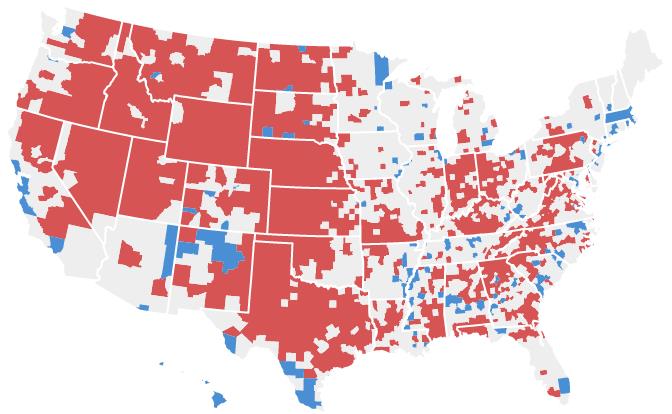
What about my liberal friends? Have they been shaken from their delusions into a realization that they might not be as numerous as they thought? Again, I’m not seeing it so far, but it’s still early days and the emotions are still raw. Below, I am going to present a series of maps to hopefully ease some of them into the process, to convince them that they are not necessarily the moral majority they like to think they are.
The maps are taken from a post-election New York Times piece. Or they may have come from The Atlantic. In any case, I can’t seem to find the article now. You’ll just have to take my word for it that the maps come from a legitimate source, and not from Breitbart or Stormfront. What they show are districts in successive presidential elections which voted either landslide Democrat (blue), landslide Republican (red), or no landslide (grey):
![]() |
| 1992 |
![]() |
| 1996 |
![]() |
| 2000 |
![]() |
| 2004 |
![]() |
| 2008 |
![]() |
| 2012 |
![]() |
| 2016 |
But there are a couple of other messages that these maps are trying to tell us. First, notice that the biggest loser on these maps over time has not been red or blue; it has been grey. Simply put, the population of the United States seems to be geographically self-segregating along party lines. There are more areas where the voting is not close. This cannot possibly be healthy. If the two sides do not start acknowledging each other’s basic humanity, there will no longer be a United States of America as such. The cracks are already appearing. Such a future is not a good one, for either red or blue Americans.
Second, at least to my mind, these maps belie the cherished liberal belief that the forces of racism took this election. If that were the case, how did Barack Obama manage to temporarily reverse the growing tide of red? Of course there have always been racists out there, plenty of them. But I doubt very much that any of them were voting Democratic in the elections that produced these maps. In order for these maps to be consistent with the racism narrative, you’d have to convince me that that many Americans across the nation suddenly became hard core racists since 2012. It’s just too implausible.
I have one more thing to say about these maps. A lot of the liberal friends I know have been expressing sentiments to the effect that all those red areas can go screw themselves. After all, Democrats won more of the popular vote in this election (as many as 2 million more votes at last count), so the democratic majority was in that sense “cheated”. In other words, this line of thought says, democracy ought to “trump” (pardon the pun) geography.
This is a dangerous way of thinking, and here’s why. The maps above show that the United States is increasingly “two nations warring within the bosom of a single state,” to use Lord Durham’s words. Now, let us suppose that demographically, one of those warring nations can be expected always to outnumber the other, as Blue Nation currently outnumbers Red Nation. Let us further imagine that there has been some kind of electoral “reform” in America, such that the electoral college has been abolished and presidents are simply elected by a plurality of the popular vote, period. The predictable result would of course be an America dominated by Blue Nation, indefinitely. If you think a two-party state is bad, try a one-party state.
What do we call it when one nation is dominated politically and subjected to the will of another nation? I think “empire” is the commonly accepted term. In such a situation, how much loyalty and obedience can be expected from the subject people? Very little. And how much political legitimacy can the dominators claim in the eyes of the dominated under such a system? Again, very little.
The American Founders were wise enough to realize that their new nation had little chance of holding together under a unicameral system of purely democratic representation. They knew that eventually a coalition of like-minded populous states could dominate the smaller ones and that the smaller ones would not stand for it. So they counterbalanced the democratic element by instituting a Senate that apportioned an equal number of representatives to each state regardless of population. Democracy is desirable, but it is not everything.
We in Canada are perhaps more aware of this than our American cousins, since Lord Durham’s words were intended to describe us. Canada is first and foremost a confederation of regions. Our nation is an ongoing experiment in holding together against the centrifugal forces of “regionalism”, an ongoing experiment in making compromises that seem on their surface to violate the democratic will of the majority. If, for example, Quebec seems to get a “special treatment” sometimes, it is because our confederation will not hold together without them. And they ultimately stay because their national identity is more secure in the long run within the confederation than outwith it.
Similarly, to Americans living in the Blue islands on the electoral map who ask why they should continue to tolerate an “unfair” system of representation that “discounts” their votes, I can only repeat the slogan of a certain Democratic candidate for president: Americans are “Stronger Together”. Such is the price of living in a federal republic, and much better than the alternative. In the meantime, rather than clamoring for recounts, and reforming the electoral system or the constitution to make them more “democratic”, it might be more constructive (or rather, less destructive) to work on ways of reversing the process of self-segregation reflected in the maps above. Such a process will necessarily involve listening and trying to understand each other.
Blue America, meet Red America. Red, meet Blue. Now start talking.
Monday, August 22, 2016
Insite in Hindsight
![]() |
| The little flower over the "i" means it's good for you |
Recently, the unthinkingly “progressive” ideologues on the city council of my hometown voted to open up three “safe injection sites”, doubtless with more to follow. Toronto has in effect decided to import a really bad idea from Vancouver. For readers in more sane jurisdictions who don’t know what a safe injection site is, it is essentially a medically safe law-free zone for junkies to shoot up in without having to worry about getting arrested or overdosing. Vancouver opened its first one in 2003.
For a conservative like me, this seems like a hare-brained scheme. But ask a progressive, and she’ll tell you it’s eminently sane and contributory to the common good. In re-posting this piece below, I ask you, which of us is right?
The piece was written back in 2011, as drug-blighted Vancouver was opening more safe injection sites. First, for the benefit of those who think state-sponsored shooting galleries are ill-advised, charity demands that I set out why its defenders think it’s a good idea. Here are what are claimed to be the main benefits of the policy: (i) addicts can receive timely medical attention should they overdose, (ii) the provision of clean needles will keep them relatively healthy and disease-free, and (iii) proximity to health services and the availability of information will hopefully attract more junkies into addiction treatment.
On the other hand, I argued that safe injection sites would send a mixed message about the social undesirability of drug abuse, thereby undermining the message that it is a behavior best avoided. Similarly, I cast doubt on the notion that more addicts would seek treatment, partly because the authorities had gone to such efforts to make drug addiction safe and comfortable, thereby removing some of the incentive to quit, and partly because there were already not enough treatment spaces available to meet current demand, let alone increased future demand.
Six or seven years on, how many of the progressive fantasies around safe injection sites have become reality in Vancouver? Strangely, when it comes to actual policy evaluation, the progressives have been eloquently quiet. From what I can tell, they were right about one thing: According to the BC Centre for Disease Control’s latest available (2014) annual report (p. 18), safe injection sites seem to have had a considerable role in reducing the rate of new HIV infections among intravenous drug users in British Columbia. That much I’ll grant.
Otherwise, to put it… ahem… charitably, the results of safe injection sites have been mixed. First, it seems to have done little or nothing to reduce overdose deaths in British Columbia. The Globe and Mail refers to a “surge” in overdose deaths since 2009. “Surge” implies something sudden, and anomalous. What we have in reality is a relatively long-term seven-year trend. Experts blame it on the advent of fentanyl abuse by addicts. I don’t buy this explanation, since this trend began long before fentanyl hit the streets. No, what we seem to have is a clear policy failure: safe injection sites are simply not preventing overdose deaths. According to the Globe article, the progressive lunatics running the asylum have a solution — more safe injection sites! Another solution is to keep the sites open 24 hours, presumably because, since making shooting up convenient didn’t work, the answer is to make it even more convenient. Granted, the 24-hour concept would only be operative Wednesday through Friday. Why? Well, because apparently “Insite has tracked a 50-per-cent increase in overdoses from January to May, 2016, specifically on the Wednesdays, Thursdays and Fridays of welfare-cheque distribution week, according to a Coastal Health statement.” In other words, public funds are being spent on government-sponsored shooting galleries in which dope will be injected that was also purchased with public funds.
Despite Insite and its ilk, junkies are still dying. I leave it to you to judge how bad a thing that is (it frankly doesn’t rank high on my list of pressing social ills). But at least they’re not getting AIDS as frequently, so in that sense, safe injection sites are keeping junkies safe. However, they are doing little to keep non-addicted Vancouverites safe, since hundreds of thousands of used needles are turning up in schoolyards, children’s playgrounds, and residents’ flower beds all over the city. Just a little taste of the progressive utopia coming soon to Toronto.
Without more ado, here’s the original post.
* * * * *
INSIGHTS FROM INSITE
For someone like me, who is of mildly conservative leanings, the application of public policy can be visualized as the dropping of a stone into a calm pond. Much like ripples, public policy has social effects that radiate outwards from the centre of social action. The most proximate effects are the ones that tend to get noticed, these being more pronounced and closer to the point of impact. The concentric circles further out are less pronounced and eventually fade away into imperceptibility.
However, while those inner ripples are fewer in number, the outer ones are more numerous and widespread. Thus, like ripples, the greater overall effects of a policy might just be those that we least take notice of. Herein lies the task of the conservative social policy analyst. Where others might be tempted to focus only on proximate effects, she must look to the long-term and often indirect effects, to that which is hidden. She must do this not out of a reflexive impulse to pooh-pooh any measure that smells like change. Rather, she must do it out of a desire to urge us to slow down, just a bit, and to consider for a moment whether we may not be creating unintended consequences through the best-laid plans of mice and men.
For some time now, there has been a social experiment going on in Vancouver’s drug-blighted Downtown East Side. It is called Insite, a program that provides a safe injection site for junkies to shoot up in. The main aim of Insite is to cut down on the rate of drug-related deaths by users. A recently-released study indicates that, by this standard, the program is a clear success. There is now talk of expanding the program to various other cities.
However, the current federal government here in Canada has always hated the idea of Insite and has bent over backwards to try to get it eliminated, to no avail so far. They don’t like the idea of coddling a group of citizens they consider to be little better than criminals, and they have gone to some lengths to provide their own counter-evidence purporting to show that Insite is actually a failure.
The government is on firmer ground when it appeals to an economic justice argument, for the fact is, Insite technically subsidizes junkies to shoot up, using funds presumably provided by taxpayers. If a convincing case can be made that taxpayers don’t want to subsidize junkies, then this to me represents a compelling case not to do so. On the other hand, if the program works, and if taxpayers can be convinced that it’s worthwhile, then, Insite is economically defensible. And if Insite relied only on charitable donations rather than tax funds, then no economic injustice would be committed. But I have a gut feeling that the current government would still hate and oppose the program in either case, so their aversion to it really has little to do with economic justice as such
I loathe the current federal government, so it pains me to find myself in ― qualified ― agreement with them. I have grave reservations about Insite. However, my reservations are not based on the federal government’s preconception that addicts are ipso facto criminals rather than persons. Thus, in what follows I will address their problems as if they were upright citizens deserving of just as much respect as you or me, albeit they happen to be citizens with a very serious health problem.
Also, my grave reservations about Insite are not based on any skepticism about the validity of the study indicating Insite’s success. I am willing to grant that the available studies are correct: Insite has been successful in its stated goal of reducing drug-related deaths in Vancouver’s Downtown East Side.
However, the successes focused on in these studies are what I was referring to above as the inner ripples of policy, its immediate or proximate effects. But what about the outer ripples, the ones that are harder to see or to measure? I heard an interview on the radio last week with a senior administrator of the program (unfortunately I didn’t catch his name). He stated that the goal of Insite was to “keep addicts disease-free until they are ready to make the decision to seek treatment for their addictions” (I’m necessarily paraphrasing here, but pretty accurately, I think).
The evidence indicates they have indeed been kept (more) disease free. This I won’t dispute. But it begs a larger question: What warrant do we have to assume that untreated addicts reliably make the decision to seek treatment? Evidence here varies, but most of what I’ve seen is not encouraging. That is one of the unseen ripples of the policy.
We can also follow the ripples a little further out. For example, what warrant do we have to assume that untreated addicts reliably make the decision to seek treatment when they receive services that enable them to continue using drugs relatively safely? If Insite facilitates addicts’ safe drug use, might it not be the case that a very strong incentive to quit ― the high probability of disease or overdose ― has been removed? This question was screaming to be answered in the interview, but neither interviewer nor interviewee seemed much interested in addressing it. On the interviewer’s part I imagine this was motivated by an implicit desire to display his social liberal credentials to a mostly like-minded CBC audience.
Defenders of Insite have argued that the availability of information and professional consultation available at Insite will help guide users to treatment options. Perhaps this is the case, but again, it is an empirical claim for which we want evidence. The report touting Insite’s success simply tells us that addicts using it are more likely to remain disease-free. It is (tellingly?) silent about how many of them end up seeking treatment. Until we have information on this, the claim that addicts who avail themselves of Insite’s services are more likely to seek treatment remains an unproven hypothesis, not a fact.
There is further reason to doubt this claim’s validity: most professionals in the “addiction services industry” (I don’t really know what else to call it) will tell you that there is a shortage of spaces available in treatment facilities. There are too few spots to service current demand, let alone an increase in demand. Logically, this means that it would be impossible to treat more patients given current resources. So Insite cannot be leading more addicts to treatment, because the treatment isn’t there for them to be led to.
Obviously this is not an argument against Insite’s claim to efficacy in bringing addicts closer to treatment. If anything, it’s an argument for an increase in resources devoted to addiction treatment. Again, however, we must consider the policy ripples a little further out. Might it be the case that the increased access to addiction treatment information is at least somewhat ― if not entirely ― offset by the convenient and comfortable drug injection environment offered by Insite? At the very least, we must admit that mixed messages are being sent here: “We’d like you to consider getting treatment for your addiction. Here’s a brochure. And here’s a clean needle and a comfy room to shoot up in.” A junkie could be forgiven for taking away from this the message that his addiction is not so bad for him after all, and that treatment is not imperative.
Much of one’s attitude toward programs like Insite will depend on the views one has about the nature of addiction itself. Addiction is a puzzling phenomenon. Once upon a time, it was simply viewed as a matter of lack of willpower, and was thus regarded as a moral problem, a moral failing. We could call this the “moral disease” view of addiction. It has to a large extent fallen out of favour among researchers (along with many other things that employ the term “moral”). Speaking very broadly, the moral disease view has largely been replaced by either of two currently popular models of addiction. Fortunately, my reservations about Insite are unaffected by whichever of these views one happens to hold.
The Disease Model
Probably the most widely accepted and fashionable paradigm for understanding addiction is the disease view, which treats it as if it were a medical condition on all fours with, say, diabetes or cancer. Of course, there is a large psychological component to this particular disease which differentiates it from purely physical conditions, but for treatment purposes, addiction on this model is seen as a medical condition, a psycho-physical sickness beyond the control of its victim. This is the operational viewpoint of most Twelve Step programs.
From what little I know about the history of addiction treatment (and it’s probably more than the average person, for personal reasons I don’t wish to expand on here), the disease model was developed in the treatment of alcoholics in the early 20th century for at least two reasons. One was that clinicians noted that chronic alcoholism had a more or less definite disease pathology, a natural progression or history of symptoms, when left untreated. Another was the hope that by seeing alcoholism as a medical condition, people would be less judgmental of alcoholics, and alcoholics would be more willing to seek treatment once the stigma of their condition was removed. In other words, it was specifically hoped that the disease model would replace the old moral disease view with its accompanying social stigma.
Both of these were valid points to some extent. Chronic and very acute alcoholism does have a fairly well-defined physical pathology. And probably more problem drinkers have ended up seeking treatment than they otherwise would have once the social stigma attached to the “disease” was mitigated.
On the other hand, not all problem drinkers fit a disease profile that was originally developed with the most advanced late-stage alcoholics in mind. It was a one-size-fits-all model that has not proved very helpful in understanding the “disease”, if disease it be. And although more people sought treatment, the treatment programs based upon this disease model have been notable only for their abysmal success rates. Alcoholics Anonymous has been around since 1939. It does not track its success rate in treating alcoholics. You’d think they would want to. But there is probably a good reason why they don’t. Others have done the studies on their behalf, and the general consensus is that Alcoholics Anonymous is a failure at keeping people sober. There are far more failures than successes, and even among the “successes”, relapse rates are sky high. If alcoholism is a disease, and if A.A. is the “cure”, then as a doctor, I’d consider taking my chances by prescribing a placebo to my alcoholic patients.
Long-time members of A.A. will counter by saying that the organization is not supposed to “keep people sober”. Alcoholics are supposed to keep themselves sober; the responsibility for recovery always lies with the alcoholic herself. But doesn’t this seem in tension with the notion that addiction is a disease for which its sufferer is not responsible? A.A. members will also tell you that failure or relapse happens because an alcoholic can’t be treated unless he “is ready” to recover, or has hit bottom and decided to give up the drink. But again, this seems in tension with the disease model’s stress upon the notion that alcoholism is not a function of the alcoholic’s lack of willpower.
Sooner or later it seems, every treatment scheme predicated on the disease model runs up against this tension. The disease model may be better at luring the addict into treatment, but at bottom, the treatments themselves end up stressing willpower and the addict’s own inner resources for recovery. Alcoholics Anonymous is no exception. As a matter of fact, their entire program of recovery can be viewed as a conscious attempt to instill in the alcoholic a transformational revolution of character, the beneficial moral effects of which will hopefully mimic those of intense religious conversion. It is no coincidence that Bill Wilson, co-founder of A.A., was greatly influenced by William James’ The Varieties of Religious Experience. It is important to stress that such an approach works on the internal resources of the alcoholic’s own moral agency, which seems rather at odds with the disease model of addiction. After all, we don’t cure cancer or diabetes by relying on the character or willpower of the patient.
In a true disease model, the patient is just that ― a patient. But addiction treatment almost always ends up (as it must, I believe) treating the patient as an agent. Perhaps the success of such programs might be improved if they were to be honest about this from the beginning. Maybe we must fess up and admit that kicking addiction is a matter of willpower after all (helped along, of course, by a certain degree of moral support from others). Obviously, putting it this way grossly oversimplifies the phenomenon of addiction. But then again, so does the disease model.
The Rational Choice Model
The other school of thought ― the rational choice model ― is less popular than the disease model, at least among clinicians. The rational choice model has been adopted mainly by behavioural economists because it fits well with the observed behaviour of addicts. In a nutshell, this model views the addict as a rational consumer, in almost all respects the same as you or me.
Generally speaking, when the price of a good increases, consumption of that good tends to fall. The rate of decrease of demand will vary from one good to another, and from one agent to another, but the general trend is obvious. The addict’s consumption of drugs is, in principle, no different. If you lower the price of cocaine or heroin, addicts will tend to increase their consumption of them, and some people will begin to consume these drugs who otherwise might not have.
The fact that the addict is addicted to the drug simply means that his demand for the drug is inelastic relative to other goods. If the price of heroin goes up, before he considers cutting down his consumption, the junkie will instead often forego food or rent. This seems like an irrational consumption choice, but if each of us were to systematically examine our own consumption choices, we would often find similar though perhaps less harmful patterns. I once knew someone “addicted” to electronic gadgets; he absolutely had to have the latest thing, spending well beyond his slender means, even if paying for it meant that he didn’t know how he would make his rent or pay off his ridiculous credit card bill. My wife might say that my penchant for book collecting meets this description. There just happens to be no self-help group akin to Alcoholics Anonymous that I know of for my particular form of consumption aberration (if there were, I’m sure my wife would have left a brochure on my pillow by now).
The rational choice model views the addict as making choices about consumption, based on what they believe will best satisfy their overall preferences. To the third party observer, these choices can seem downright irrational, but to the person making the choice it seems perfectly rational: they have a (very strong) desire for a drug, which gives them pleasure or ― what amounts to much the same thing ― relieves their pain. Any approach to treating the addict should treat them as rational persons making choices based on a preference set and an information set. Such an approach would work on improving their decision-making by modifying their preferences and providing them with information. Inevitably, there will also be situational and environmental factors standing in the way of better decision-making, things such as easy availability of the drug, hanging out with the wrong crowd, etc.
The point is, rather than approaching the addict as a powerless patient whose addiction is an external force majeur that strikes him through no fault of his own (the disease model), the rational choice model treats the addict as an empowered, decision-making agent, responsible for his own conduct. He ought to be praised for his good choices, especially when, as in the case of addiction, good choices are difficult choices. And he ought to be held responsible for his bad ones. The prevailing view that addiction seizes and controls the addict, as well-intentioned as it might be, is probably misguided. It is one part of an overall tendency to “medicalize” conduct that is moral in nature. I will illustrate this medicalization of moral conduct with an anecdote from an essay by Theodore Dalrymple.
Dalrymple was a prison psychiatrist. He was interviewing an inmate who was in prison for viciously beating up his girlfriend badly enough to put her in the hospital. This was not unusual behaviour for this particular inmate. Dalrymple asked him why he beat up his girlfriend. He replied to the effect that he had difficulty controlling his anger and she had made him really angry. Not really his fault, you see. The general gist of his answer was that he was in prison due to a problem largely beyond his control ― he had “anger management issues”, to use the parlance of our times. He simply couldn’t help beating his girlfriend to a bloody pulp. Dalrymple then asked him how it was that since he had been in prison he had managed to be well-behaved, with no outbursts of anger or violence. He replied that the guards didn’t let prisoners get away with that kind of bullshit in prison.
The prisoner had ascribed his violent behaviour to a quasi-disease model of anger, which he probably picked up by osmosis from the liberal claptrap he was hearing around him. Working from within the disease model, the prisoner’s subsequent good conduct behind bars makes no sense. But working from the rational choice model, it makes perfect sense. He was able to modify his behaviour in the presence of a strong incentive, namely getting the proverbial tar beaten out of him by a prison guard. Research on addiction done by behavioural economists bears this phenomenon out.
This has obvious implications for programs like Insite. When we ask ourselves what motivation Insite offers addicts to quit, we mostly come up empty-handed. Again, yes there are brochures and addiction counselors, but there are also the clean needles and the safe and comfy shooting galleries that cancel these out. The rational choice model predicts a poor long-term treatment prognosis for users of Insite. I hope someone will do the research to test this hypothesis. It represents one of those outlying ripples of this particular social policy, one of those rare ones that is, in principle, empirically measurable. And the test should probably happen before the program is expanded, not afterward. That is how conservative policy analysis should work.
Wednesday, July 27, 2016
Our Robots, Ourselves
Anyone who has been following the US election spectacle — and really, the media have made it impossible not to — will by now realize that the insurgencies of Donald Trump and Bernie Sanders are a collective cry for help from the middle and working class. People are struggling, and the usual ways of doing things have not helped them one iota. Hollowed-out factory towns, main streets full of boarded up shops, and parents whose lives now revolve around heroin rather than around jobs that pay a living wage. These are the legacies of several decades of politics as usual.
Despite their quite radical ideological differences, there is an interesting and significant overlap between them on this issue: both acknowledge (or at least claim to acknowledge) the growing numbers of formerly prosperous Americans who have fallen through the cracks. I never in my lifetime thought I’d hear the presidential nominee for the Republican Party call for ripping up trade deals and penalizing companies that offshore jobs. That kind of Bolshevism is not the usual stuff from which Republican presidential hopefuls are made. And to find that these positions of Trump’s tally with those of Sanders, well, we live in interesting times.
However, even within these broad areas of agreement between Trump and Sanders, there are more subtle differences. Each of them blames the problems facing the working class on different enemies. Regarding trade deals, Bernie Sanders views the Trans-Pacific Partnership (TPP) as the devil’s right hand, while Trump views the North American Free Trade Agreement (NAFTA) as the worst trade deal in the history of the United States. Sanders blames offshoring for job losses, while Trumpian nativism tends to focus on the role of (illegal?) immigrants in supposedly taking jobs away from hardworking American-born citizens.
I read an article recently that made me think they were both missing what is — or is about to become — the biggest enemy facing the middle class, namely robots. The article was about how workers in China are being replaced by robots. The Chinese wage differential that was boosting their economy to such heights is no longer a comparative advantage. Soon, it seems, there won’t be anywhere left in the world where humans are cheap enough to hire. Embedded in the article were some statistics on the purchasing of industrial robots around the world that made for chilling reading. For the benefit of readers, I have charted the numbers and provided year-over-year percentage changes. Here is the picture worldwide:
These numbers are just for the past few years. Note particularly the large jump from 2015 to 2016. Now, here is the picture for North America (the US, Canada, and Mexico):
“Roboticization” is not as pronounced in North America, at least as judged by year-over-year increases. But I posit that this is simply an indicator of a mature economy that has been roboticizing for decades now. On the other hand, the chart shows a steady increase, without the dip in year-over-year increase that occurred in the worldwide numbers between 2014 and 2015. And the surge in the red line between 2015 and 2016 is still very pronounced in North America.
Now, what do these numbers have to tell us about the human impact of roboticization? The article mentions a kitchen utensils factory in Foshan, China, which replaced 256 workers with nine robots. If, therefore, we were to assume that each new industrial robot represents 28 jobs lost, it would mean that some 1,232,000 North American workers are poised to lose their jobs in 2016. Of course, many of these jobs will be Mexican, which won’t cause many Trumpists to shed tears. But still…
It might be the case that the robots in the Chinese example are extraordinarily efficient. For the sake of argument, let's instead assume that on average each new North American robot only replaces five workers — an admittedly arbitrary number. In that case, “only” 220,000 workers will lose their jobs to robots in 2016. But look again at that red line, at that year-over-year increase in robot purchases. If that increase only remains where it is, another 276,540 people will lose their jobs in 2017. The damage really begins to add up. And this is not a new process. It has been going on for awhile now. Is it possible that robots have something to do with all the empty factories, boarded up shops, abandoned homes?
So far, to my knowledge, this issue hasn’t made it into the campaign speeches of either Sanders or Trump (or anyone else, for that matter). They instead blame job losses on illegal “aliens”. Or on bad trade deals. Or on offshoring. Or, in Sanders’ more vague language, on “Wall Street”. Any of these might be a contributing factor to some extent. But look just look at at those numbers above. At some point in the not-too-distant future politicians will have no choice but take notice, as roboticization advances and becomes as plain as the nose on one’s face.
It may happen sooner rather than later if roboticization moves up the income ladder and starts gobbling up white collar jobs. We are on the cusp of a brave new world of robots, artificial intelligence, and big data, a world in which a chatbot can already outperform lawyers in overturning parking tickets.
Imagine it: a world without lawyers. Maybe they can replace our politicians too. I for one welcome our new robot overlords.
It raises some philosophical questions. If we are all fated to be replaced by robots and chatbots, what do we say about a species that makes itself obsolete? Or, if we find a way to structure our economy such that "benevolent" robots have merely freed us all from drudgery to do more pleasurable things, what do we say about a species that only lives for pleasure? What is the place of work within humankind's moral economy?
Despite their quite radical ideological differences, there is an interesting and significant overlap between them on this issue: both acknowledge (or at least claim to acknowledge) the growing numbers of formerly prosperous Americans who have fallen through the cracks. I never in my lifetime thought I’d hear the presidential nominee for the Republican Party call for ripping up trade deals and penalizing companies that offshore jobs. That kind of Bolshevism is not the usual stuff from which Republican presidential hopefuls are made. And to find that these positions of Trump’s tally with those of Sanders, well, we live in interesting times.
However, even within these broad areas of agreement between Trump and Sanders, there are more subtle differences. Each of them blames the problems facing the working class on different enemies. Regarding trade deals, Bernie Sanders views the Trans-Pacific Partnership (TPP) as the devil’s right hand, while Trump views the North American Free Trade Agreement (NAFTA) as the worst trade deal in the history of the United States. Sanders blames offshoring for job losses, while Trumpian nativism tends to focus on the role of (illegal?) immigrants in supposedly taking jobs away from hardworking American-born citizens.
I read an article recently that made me think they were both missing what is — or is about to become — the biggest enemy facing the middle class, namely robots. The article was about how workers in China are being replaced by robots. The Chinese wage differential that was boosting their economy to such heights is no longer a comparative advantage. Soon, it seems, there won’t be anywhere left in the world where humans are cheap enough to hire. Embedded in the article were some statistics on the purchasing of industrial robots around the world that made for chilling reading. For the benefit of readers, I have charted the numbers and provided year-over-year percentage changes. Here is the picture worldwide:
Now, what do these numbers have to tell us about the human impact of roboticization? The article mentions a kitchen utensils factory in Foshan, China, which replaced 256 workers with nine robots. If, therefore, we were to assume that each new industrial robot represents 28 jobs lost, it would mean that some 1,232,000 North American workers are poised to lose their jobs in 2016. Of course, many of these jobs will be Mexican, which won’t cause many Trumpists to shed tears. But still…
It might be the case that the robots in the Chinese example are extraordinarily efficient. For the sake of argument, let's instead assume that on average each new North American robot only replaces five workers — an admittedly arbitrary number. In that case, “only” 220,000 workers will lose their jobs to robots in 2016. But look again at that red line, at that year-over-year increase in robot purchases. If that increase only remains where it is, another 276,540 people will lose their jobs in 2017. The damage really begins to add up. And this is not a new process. It has been going on for awhile now. Is it possible that robots have something to do with all the empty factories, boarded up shops, abandoned homes?
So far, to my knowledge, this issue hasn’t made it into the campaign speeches of either Sanders or Trump (or anyone else, for that matter). They instead blame job losses on illegal “aliens”. Or on bad trade deals. Or on offshoring. Or, in Sanders’ more vague language, on “Wall Street”. Any of these might be a contributing factor to some extent. But look just look at at those numbers above. At some point in the not-too-distant future politicians will have no choice but take notice, as roboticization advances and becomes as plain as the nose on one’s face.
It may happen sooner rather than later if roboticization moves up the income ladder and starts gobbling up white collar jobs. We are on the cusp of a brave new world of robots, artificial intelligence, and big data, a world in which a chatbot can already outperform lawyers in overturning parking tickets.
Imagine it: a world without lawyers. Maybe they can replace our politicians too. I for one welcome our new robot overlords.
It raises some philosophical questions. If we are all fated to be replaced by robots and chatbots, what do we say about a species that makes itself obsolete? Or, if we find a way to structure our economy such that "benevolent" robots have merely freed us all from drudgery to do more pleasurable things, what do we say about a species that only lives for pleasure? What is the place of work within humankind's moral economy?
Subscribe to:
Posts (Atom)