A Curious Miscellany of Items Philosophical, Historical, and Literary

Manus haec inimica tyrannis.
Showing posts with label Shaftesbury. Show all posts

Thursday, March 24, 2022

Notes & Queries: Bird of Liberty

Hint: It's not him.
Repeat visitors to this blog will know that The Spectacled Avenger’s favourite book is Lord Shaftesbury’s Characteristicks of Men, Manners, Opinions, Times. I have a particular fascination with the engravings commissioned for the second edition (1714), executed by Simon Gribelin. These consisted of a large frontispiece plate for each of the three volumes of the work, with elaborate headpiece engravings designed for the individual treatises that comprise its entirety. Most (but not all) of these engravings have a tripartite structure, and all of them are intended as emblematic illustrations of key parts of the text.

I was lately pondering the significance of the storks in the bottom panel of the triptych to the plate for Volume I:


Why storks? They must have some significance. In interpreting the meaning of Shaftesbury’s emblems, there are, generally speaking, two loci classici. One is the so-called “Virtuoso-Coppy Book” or set of detailed instructions that Shaftesbury sent from Naples (where he was dying) to Gribelin in London. The second is a 1974 paper by Felix Paknadel, “Shaftesbury’s Illustrations of Characteristics”.

Turning to Paknadel, here is what he notes about this panel:

“Shaftesbury had thought of the picture of ‘a boy holding the cap of Liberty in a triumphing manner’, but then decided to keep the boys for the ‘treatise plates’, which were to be of a lighter character. The lower border represents social harmony [on one side ‘two right hands meeting and clasped’ above the three altars of different forms; on the other side, the emblems of music] and prosperity, mainly in the oval frame [night and day-the face of Apollo at the top, that of Diana at the bottom abundance reigns-cornucopias, a vine growing up a tree, the Rotundo and a ‘palace in good repair’, the caduceus with two wings, the two storks ‘which with their wings seem to support the work above’]. The motto ‘FEL.TEM.’ is the abbreviation of ‘Felicia Tempora’…. The social implication of the whole emblem is clear. Freedom, maintained by a wise ruler, breeds social harmony and fosters the development of civilization.” (p. 299)

No enlightenment here; just the laconic mention that the storks exist and that they support the larger panel above it (not reproduced here). As a gloss, this is no more informative than the “Virtuoso-Coppy-Book”, indeed, it simply reproduces the relevant passage from the Copy-Book. The latter also fails to explain the significance of the storks, though it does mention that they are significant (“essential”):

“Note that in the mere Grotesque-Work of this Under-Border there are four Pieces essential vizt. The Two Storks which with their Wings seem to support the Work above, and between their allmost joyning Bills (just at the Top the Oval frame-Work) the Head or rather Face of an APOLLO…” (Virtuoso-Coppy-Book 184)

(Sadly, it is worth mentioning that the design for this Volume I frontispiece is the only one for which Shaftesbury lived to see Gribelin’s finished plate.)

Now, it often happens that one cannot “read” one of these plates in isolation from the others. In this case, for reasons I won’t elaborate on here, it bears a relationship to the bottom panel of the triptych to the plate for Volume III. Suffice to say that, whereas the former illustrates the fruits of political and religious liberty, this one is meant to illustrate the evils of a policy of tyranny, superstition, and religious bigotry. Here is that panel:


 The twin storks in the earlier panel have been replaced with

“two metamorphos’d Human Forms which seem of a female Kind and serve as Supporters, back to back, against the Frame-Work, [and] must appear blind-folded.” (Virtuoso-Coppy-Book 154)

Here is Paknadel’s gloss:

“The results of such a policy are shown in the oval frame. [The ancient monuments are tumbling down; day is turned into night, birds of bad omen are flying; the vine has become a bare tree. The faces of Apollo and Diana are replaced by those of Ignorance at the top and Stupidity at the bottom; the storks by two blinded females. The motto is now EN QUO, the abbreviation meaning ‘Behold, whither are we brought! To what state reduced!’]” (pp. 304-305)

I did recently chance upon a rather obscure connection between the above-mentioned “birds of bad omen” and storks. In his posthumous Select Discourses (1660), the Cambridge Platonist philosopher John Smith (1618-1652) makes the following remark: “as Aelian observes of the Stork, that if the Night-owle chanceth to sit upon her eggs, they become presently as it were υπηνεμια, and all incubation rendred impotent and ineffectual” (p. 7). (The reference is to Book I.37 of Aelian’s De natura animalium.)

Now, this is all very interesting, one supposes. But still my question persists: why storks? If he simply needed some creature as mere ornament to frame the head of Apollo, presumably any bird would do. Why not eagles? Or roosters? Shaftesbury doesn’t tell us, and Paknadel makes no attempt to decode the symbolism of the storks, if indeed there is any.

In my experience, when in need of information about the traditional lore of the natural world, it is often helpful to reach for Pliny, or, failing that, to pull Sir Thomas Browne (1605-1682) from the shelves. Lo and behold, in the latter’s Pseudodoxia Epidemica (1646, last revision 1671), Bk. III, ch. 27, we find out that it was once a commonly held belief that “Storks are to be found, and will only live, in Republikes or free States”. Browne’s work does not appear in Shaftesbury’s library catalogue as it has come down to us, but no doubt he was familiar with the notion.

Incidentally – this entire post has been incidental – we also learn from Browne (Bk. V, ch. 22) that the owl had historically been seen as a harbinger of misfortune, and by extension had in his time become emblematic of superstition.


Bibliography

BROWNE, Sir Thomas. The Works of Sir Thomas Browne (Vol. II: Pseudodoxia Epidemica). Geoffrey Keynes (ed.). London: Faber and Faber, 1964.

PAKNADEL, Felix. “Shaftesbury’s Illustrations of Characteristics,” Journal of the Warburg and Courtauld Institutes 37 (1974), 290-312.

SHAFTESBURY, Anthony Ashley Cooper, 3rd Earl of. Characteristicks of Men, Manners, Opinions, Times (3 vols.). Indianapolis: Liberty Fund, 2001.

—— PRO 30/24/24/13. (“Virtuoso-Coppy-Book”, consisting of Shaftesbury’s instructions for the engravings in Characteristicks.) Reproduced in Standard Edition (Vol. I,3), Wolfram Benda (ed.). Stuttgart-Bad Cannstatt: Friedrich Fromman Verlag, 1992. 

—— PRO 30/24/23/12. (“Catalogus Librorum Anglicorum, Gallicorum, Italicorum etc…. Anno Ærae Christianæ 1709”, catalogue of works in vernacular languages in Shaftesbury’s libraries in Chelsea and St. Giles.)

SMITH, John. Select Discourses. London: J. Flesher for W. Morden, 1660.


Thursday, December 2, 2021

Notes & Queries: Amicable Collisions


Occasionally, upon reading a work of literature, one comes across a phrase, a sentence, or a thought that is particularly well-expressed, and gets echoed down the years in the works of other authors with whom it resonates. Sometimes it’s just that – an echo, so faint it might have come from somewhere else. Sometimes it’s clear as a bell, though even then the writer might not be fully conscious of its origin.

And sometimes, because the thought behind the phrase is commonplace – though perhaps never so well-turned – one is apt to wonder whether it was the original invention of that author, or whether he had cribbed it from someone else (again, perhaps unconsciously).

There is a line in Lord Shaftesbury’s Characteristicks of Men, Manners, Opinions, Times (1711), which struck me the first time (of many) that I read it:

“All Politeness is owing to Liberty. We polish one another, and rub off our Corners and rough Sides by a sort of amicable Collision” (Vol. I, p. 64).

I would not go out of my way to argue that the thought is original to Shaftesbury. But one finds it in many later writers, expressed in words so similar, that there can be no mistaking the provenance. Here are a few examples:

I like the description of your pic-nic, where I take it for granted, that your cards are only to break the formality of a circle, and your Symposion intended more to promote conversation than drinking. Such an amicable collision, as Lord Shaftesbury very prettily calls it, rubs off and smooths those rough corners, which mere nature has given to the smoothest of us.” Lord Chesterfield, letter to his son (29 October 1748).

(No mistaking that one; it’s a direct citation.)

“The genius of a people where nothing but the monarchy is salique, having ceded this department, with sundry others, totally to the women – by a continual higgling with customers of all ranks and sizes from morning to night, like so many rough pebbles shook long together in a bag, by amicable collisions, they have worn down their asperities and sharp angles…” Laurence Sterne, A Sentimental Journey through France and Italy (1768), p. 54.

“It was those Meetings in particular [i.e. of the Select Society], That Rub’d off all Corners as we call it, by Collison [sic.], and made the Literati of Edinr. Less Captious and Pedantick than they were Elsewhere.” Alexander Carlyle (1722-1805), Anecdotes and Characters of the Times, p. 150n.

From the above fairly obvious allusions, we descend to the less obvious. Here, they tend to fall into two classes: a) they either borrow Shaftesbury’s idea and express it in different words, or b) they borrow Shaftesbury’s imagery to express a thought somewhat different. The next example is Samuel Johnson’s verbose but elegant expansion of (what I believe to be) his source in Shaftesbury:

“In cities, and yet more in courts, the minute discriminations which distinguish one from another are for the most part effaced, the peculiarities of temper and opinion are gradually worn away by promiscuous converse, as angular bodies and uneven surfaces lose their point and asperities by frequent attrition against one another, and approach by degrees to uniform rotundity.” Samuel Johnson, Rambler No. 138 (13 July 1751).

Although the wording is quite different from Shaftesbury’s, the thought is very similar. Except that here, Johnson puts his own typically pessimistic spin on it: Yes, liberty enables us to rub off our rough corners in a sort of amicable collision, but we get polished down to a sameness in the process; there is a loss of individuality and variety. Politeness leaves little room for eccentricity.

In the next example, from Herder (1744-1803), Shaftesbury’s idea is extended from individuals to polities:

“[S]o many edges had first to be worn down with force before that round, smooth, well-behaved thing which we are could appear!… Behold how these great state-bodies, within which mankind is no doubt best cared for, are now rubbing against one another without destroying each other, and cannot ever destroy each other!” Johann Gottfried Herder, Another Philosophy of History for the Education of Mankind (1774), §2

The next two examples are of interest for their authors’ genealogical proximity to Shaftesbury. In a very Shaftesburean philosophical dialogue, his nephew James Harris (1709-1780) offered up this line:

“My Reproaches produced a sort of amicable Controversy.” Three Treatises (1744), in The Works of James Harris, Esq. (1801), Vol. I, pp. 25-26:

One cannot help but think that Shaftesbury’s more famous descendent, the 7th Earl, had this passage of his ancestor’s in mind when, in the preface to his a collection of his speeches, speaking of the mental life of the agricultural labourer, as contrasted with the urban industrial labourer, he wrote:

“He has not, of course, the acquirements and acuteness of the urban operative; his labour is passed in comparative solitude, and he returns to his home at night, in a remote cottage or a small village, without the resource of clubs, mechanics’ institutes, and the friction of his fellow-men” [italics added]. Speeches… upon Subjects Having Relation Chiefly to the Claims and Interests of the Labouring Class, (1868), p. viii.

I assuming throughout here that the third Earl’s phrasing was original (corners and rough sides, amicable collision, etc.), if not the idea itself.

QUERY: Was it? Is there a predecessor whom Shaftesbury was imitating, much like the above authors imitated him?

Though not identical, here is a candidate:

“Moreover, thanks to the prizes which a republic offers, an orator’s intellectual gifts are whetted by practice, burnished, so to speak, by friction, and share, as is only natural, the light of freedom which illuminates the state.” Longinus, On the Sublime, 44.3.

*          *          *          *          *

Bibliography

CHESTERFIELD, Philip Dormer, 4th Earl of. Selected Letters of Lord Chesterfield. London: Oxford University Press, 1929.

HARRIS, James. The Works of James Harris, Esq. (2 vols.). London: F. Wingrave, 1801 (facsimile, Bristol: Thoemmes, 2003).

HERDER, Johann Gottfried. Another Philosophy of History for the Education of Mankind. Ioannis D. Evrigenis and Daniel Pellerin (trans.). Indianapolis: Hackett Publishing, 2004.

JOHNSON, Samuel. Works (12 vols.). London: F. C. and J. Rivington et al., 1823.

SHAFTESBURY, Anthony Ashley Cooper, 3rd Earl of. Characteristicks of Men, Manners, Opinions, Times (3 volumes). Indianapolis: Liberty Fund, 2001. 

SHAFTESBURY, Anthony Ashley Cooper, 7th Earl of. Speeches of the Earl of Shaftesbury, K. G. upon Subjects Having Relation Chiefly to the Claims and Interests of the Labouring Class. London: Chapman and Hall, 1868. 

STERNE, Laurence. A Sentimental Journey through France and Italy by Mr. Yorick, to which are added The Journal to Eliza and A Political Romance. Ian Jack (ed.). London: Oxford University Press, 1968.


Friday, December 13, 2019

Before Collier

William Congreve
In 1698, a clergyman named Jeremy Collier (1650-1726) published a pamphlet entitled A Short View of the Immorality and Profaneness of the English Stage. It was one of those little works that, while almost completely unread now, had an outsize effect in its day, in this case on English theatre. In it, Collier denounced the English stage for its perceived propagation of every kind of vice: profanity, blasphemy, sexual license, irreligion, you name it. Theatre had become a threat to public morals.

It would be easy to write Collier off as yet another Puritan killjoy. However, he is worth taking seriously for a few reasons. For one thing, he was not a Puritan or dissenting “fanatic”; he was a High Church Tory. In other words, he was a representative of The Establishment, and therefore could not be written off so easily by the beau monde. Second, his work touched a nerve, even with the playwrights whose works he attacked. Collier marks a turning point.
For the English stage, and for English comedy in particular, the period up to 1698
BC (“Before Collier”), is broadly spoken of as the period of “Restoration Comedy”. It is marked by all the excesses one associates with the stereotyped culture of the Restoration, its debauchery, sexual license, and general indifference towards received moral and religious norms. The language of Restoration Comedy was bawdy and demotic. Its stock characters were the prostitute, the pimp or procurer, the young rake, the rich and horny widow, the young and horny wife (and her cuckolded husband). What is now rightly considered “sexual assault” was a very frequent plot device in the comedies (!) of the age. Bill Cosby could have plied women with drugs in one of these plays to great comic effect if he were living in London in the 1670s. All of which is to say that, rather than being just another dour crank, Collier had a point.“AC” or after Collier, the language of comedy becomes more subdued. The plots are less “rapey”. Attempted seduction or adultery is less often successful, and unhappily married couples are reconciled at the end. There are happy endings for the virtuous – or for the repentant – and vice comes to a bad end. In short, playwrights started writing plays differently, or like William Congreve (1670-1729), left off writing plays altogether.

Congreve is actually my reason for writing this. I had read The Way of the World (1700) many years ago and remembered little of it. In my mind, Congreve represented the polite, neoclassical – “after Collier” – generation of writers I associate with the likes of Addison and Pope. There is no real reason for this other than my general ignorance of his works, and the mental image I have of that Kit-Kat Club portrait of him by Sir Godfrey Kneller. I was disabused of this assumption after recently reading all his comedies and finding them to be firmly in the Restoration tradition.

Besides having all the louche elements of Restoration Comedy abovementioned, I was also very alert to a number of Rochesterian references in these plays. By “Rochesterian” I mean references to the writings of the naughty Earl of Rochester (1647-1680), a poet almost synonymous with the moral and spiritual bankruptcy of Restoration libertinism. And although Rochester died when Congreve was about 10 years old, there would have been a direct link between the two men through the person of Elizabeth Barry (1658-1713).

Barry was an actress who had roles in all four of Congreve
s comedies, though by this late stage of her career she was relegated to playing older parts. For our purposes, what matters is that Elizabeth had been the mistress of Rochester, to whom she bore a daughter. Tradition has it that Elizabeth’s inaugural appearance on the stage was a complete disaster, but that Rochester took her under his wing and coached her. She went on to become one of the most celebrated actresses of the age. She also dumped Rochester.

The first Rochesterian reference I came across in Congreve’s plays was actually not penned by Congreve himself. Rather, it was written by Thomas Southerne in some commendatory verses prefixed to Congreve’s The Old Batchelour (1693):

     She yields, she yields, surrenders all her Charms,
     Do you but force her gently to your arms
     (“To Mr. Congreve”, ll. 14-15)


Aside from its rapiness, it is also reminiscent of Rochester’s lines:

     Shee yields, she yields, Pale Envy said Amen
     The first of woemen to the Last of men.
     (“Sab: Lost”, ll. 1-2)


In the same play, Belinda admonishes Araminta (Act II, scene ii):


"Oh, you have raved, talked idly, and all in Commendation of that filthy, awkard, two leg’d Creature, Man."

In sentiment and phrasing it brings to mind the opening lines to Rochester’s “A Satire against Mankind”:
 

     Were I (who to my cost already am
     One of those strange prodigious Creatures Man)
     A Spirit free, to choose for my own Share,
     What Case of Flesh, and Blood, I pleas’d to weare,
     I’d be a Dog, a Monkey, or a Bear,
     Or any thing but that vain Animal,
     Who is so proud of being rational.


In Love for Love (1695), the free-speaking Scandal gives his opinion of women’s virtue (Act III, scene i):


"Yes, Faith. I believe some Women are Virtuous too; but ‘tis as I believe some Men are Valiant, thro’ fear."

The line illustrates a very prominent notion in Restoration libertinism, namely that it is our very vices that underpin and motivate our supposed “virtues”. It is the received depth psychology of Restoration moral cynicism, made popular and borrowed wholesale from Rochefoucauld. The idea that valor is at bottom sublimated cowardice appears several times in Rochefoucauld’s work, as in the following instance:

"Perfect Valour and perfect Cowardice are Extremes Men seldom arrive at…. Some are not at all Times equally exempt from Fear: Others give occasionally into general Panics: Others advance to the Charge because they dare not stay in their Posts."

However, when Congreve has Scandal say that some men are valiant through fear, he more likely has Rochester in mind, who in the same “Satire against Mankind” (ll. 158-159) famously wrote:

     For all Men, wou’d be Cowards if they durst:
     And honesty’s against all common Sense.


It was a well-known line, and also appears in Lord Shaftesbury’s Characteristicks of Men, Manners, Opinions, Times (1711), Vol. I, p. 119:

"And all Men (says a witty Poet) wou’d be Cowards if they durst."

Congreve’s last and most well-known comedy, The Way of the World (1700), is the only one to appear after Jeremy Collier’s attack. Indeed there are a couple of half-hearted jabs at Collier and his ilk, to little effect. After this play, Congreve gave up writing plays. Although not strictly true, it is tempting to consider The Way of the World as the last Restoration comedy. In any case, at one point (Act IV, scene i), Millimant is walking around, distractedly reciting lines to herself from the Cavalier poet, Sir John Suckling. The scattered lines she repeats here and there, taken out of context, can clearly be given a sexual meaning:

     prithee spare me gentle Boy,
     Press me no more for that slight Toy.


and

     I swear it will not do its part,
     Though thou do’st thine, employ’st the Power and Art.


After these last two lines, Millimant interrupts herself:

     Natural, easy Suckling!

It is a paraphrase of a line from Rochester’s “Timon, A Satyr” (ll. 108-108):

     Falkland, she prais’d, and Sucklings, easie Pen
     And seem’d to taste their former parts again.


Here the sexual meaning is less subtle: “suckling” of “pens” and “tasting” of “parts”. It is typical of Rochester, whose mind dwelled in a universe almost metaphysically constituted by sex, where even the trees in St. James’ Park “fuck’d the very Skies”.

The metaphysics of the post-Collier theatrical universe would be structured more politely.


Bibliography

CONGREVE, William. The Comedies of William Congreve. Anthony G. Henderson (ed.). Cambridge: Cambridge University Press, 1982.

ROCHEFOUCAULD, François, Duc de La. Moral Maxims by the Duke de la Roche Foucault. Translated from the French. With Notes. London: A. Millar, 1749.

ROCHESTER, John Wilmot, Earl of. The Poems of John Wilmot, Earl of Rochester. Keith Walker (ed.). Oxford: Basil Blackwell, 1984.

SHAFTESBURY, Anthony Ashley-Cooper, 3rd Earl of. Characteristicks of Men, Manners, Opinions, Times (3 vols.). Douglas Den Uyl (ed.). Indianapolis: Liberty Fund, 2001.


Monday, December 4, 2017

The "Dublin 1743" Edition

Detail from John Brooks' portrait
In his 1967 paper “English Editions of Shaftesbury’s Characteristics” (mentioned previously), William Alderman compiled a list of editions of Shaftesbury’s book, from which he excluded ones that were merely apocryphal, ones for which he could not track down and examine a physical specimen. Among these was a “Dublin 1743” edition. What he wrote of that edition is worth quoting at length: 

“Some years ago a reputable London bookseller offered me a ‘Fourth Edition. Dublin. 1743 (Vol. 2 and 3 dated 1723) 3 Vols. 8vo.’ In reply to a questioning letter that I sent him, he confirmed the claim that Vol. I was dated ‘Dublin 1743’ and that it was described on the title page as ‘The Fourth Edition.’ I ordered it immediately, but was told that this item had already been sold. I then asked that the sale be traced, but was told that not a private collector but another bookseller had purchased it. This second company could not trace the resale. I then wrote the Library of Trinity College, Dublin, but was told that neither it nor the National Library of Ireland owned a ‘Dublin. 4th edition. 1743.’ The reply went on to suggest that the 1743 edition ‘is a pirated edition.’ That was finis to that pursuit. Perhaps on someone’s library shelf there is an edition whose title page to the first volume says ‘Dublin 1743’; but I do not feel justified in including it with the other editions of which I am certain…. Only editions that I own or that I have examined elsewhere have been included. This means that I have disregarded the doubtful 1750, 1761, 1767, 1789, and the ‘Dublin 1743’ editions.” (pp. 317-318)

As I mentioned in my previous post, I ordered from Ebay a 1743 octavo edition of Characteristicks from a seller in Cheshire, England. As with Alderman’s attempt to purchase the Dublin edition, this bookseller’s listing was for Volume I only. The bookseller listed the location of publication as London (as we’ll see, this is only partially true).

The book has now arrived and I’ve had a chance to subject it to some examination. Its binding is probably original, though it is in rough shape. There is some damp staining and the book is in an overall condition a bookseller might plausibly rate as “fair”. In terms of provenance, the ownership markings do not go very far back in time. There is a tiny strip of an ownership label pasted into the gutter on page 7, which says “CHARLES POYSER, Summer-hill, Wrexham”. There is a very faint inscription on the title page, which I can barely make out: “From Antonio [Joze?] Sale March 30th 1858 Charles Poyser”. The same Charles Poyser’s name appears in an inscription on the inside front cover, along with that of “Sidney Poyser 1871”.

In a copy of Volume I of Characteristicks, one would expect to see a main title page by way of introduction to all three volumes, followed by a volume-specific title page. In the earlier “official” editions, this main title page would also contain Gribelin’s circular medallion engraving. My 1743 copy lacks such a main title page. Instead, the frontispiece portrait of Shaftesbury faces the volume title page, with its larger plate, and lists no publisher, only stating “Printed in the Year M.D.CC.XLIII.”


Some things to note about the two engravings in the above picture. First, the volume plate is not by Gribelin. Instead, it bears the inscription of John Brooks, as do two of the other engravings in the volume. Brooks was an engraver who worked in Dublin until 1747, when he moved to London. In 1743, his business would have been struggling, after his talented assistant, Andrew Miller, left him to set up shop on his own. In 1747 Brooks folded his Dublin business and moved to London. Interestingly, the best catalogue of Brooks’ work I can find does not list this job.
 

Inscription of John Brooks

Brooks' 1743 copy
Second, the portrait of Shaftesbury does bear the inscription of Gribelin. However, upon close examination, I can tell that it is a very well-executed copy. First, take a close look at the following two details:

Original Gribelin
Note that the loop on the initial “T” extends beyond the portrait border in the 1743 version. Also, Closterman’s name is taller and “loopier” in the 1743 version. Finally, the overall alignment of lettering with portrait differs between the two versions. There are also more subtle differences that I’m not sure can adequately be illustrated here. For instance, in looking at Shaftesbury’s head, the facial features seemed more rounded and the wig piled a little higher in Gribelin’s version than in the 1743 one. So, despite what it says, the 1743 portrait plate is not by Gribelin, though it is a quite good copy.

In all, there are three engravings in the volume that bear Brooks’ name: (i) the volume plate, (ii) the headpiece for the “Preface” picturing Shaftesbury’s coat of arms, and (iii) the headpiece to the Letter concerning Enthusiasm. There are three engravings in the volume bearing Gribelin’s name: (iv) the portrait of Shaftesbury, (v) the headpiece for Sensus Communis, and (vi) the headpiece for Soliloquy. For reasons already discussed (and one more to be mentioned), the portrait cannot be attributed to Gribelin; in the absence of any better evidence, I will hereafter assume that it too is Brooks’ work. Aside from that one, all plates bearing Gribelin’s name are indistinguishable from the originals and must be presumed to be genuine.
 

A “Dublin” Edition? 

Given that the majority of the plates in the 1743 volume were executed by an engraver known to have been based in Dublin at the time of printing, is it safe to assume that this is a Dublin printing of Shaftesbury’s Characteristicks? The answer is yes — and no.

For the most part, the volume is printed on a relatively high-quality paper; the stock is thick, with a smooth finish. However, a few pages here and there are printed on a thinner stock of inferior quality. These few pages are precisely the ones containing Brooks’ plates. The Gribelin plates always appear on the thicker stock. One other anomaly appears on page 3, which contains the headpiece to the Letter concerning Enthusiasm engraved by Brooks, there is no page number, whereas in all the early editions published with Gribelin’s engravings, this page contains the page number.

In attempting to explain these anomalies, my first hypothesis was that in 1743, some owner of an earlier edition of Characteristicks who was based in Dublin or environs was missing a few pages from his copy and had the missing pages privately printed. He chose to put the 1743 date on the new title page instead of whatever the original date was. Why? Well, perhaps he simply bought an odd (and damaged) volume and, because it was missing the title page, he had no way of knowing precisely which edition he had. (Incidentally, this would also explain the missing main title page. After all, why have that printed when you don’t actually own all three volumes?) As implausible as all of this sounds, it would at least have explained:


  • the fact that this job of Brooks’ does not appear in the catalogues of his works, and
  • the fact that there only seems to be the one example of this so-called “Dublin edition” of Characteristicks (i.e. mine. This presupposes that the one Alderman was tantalizingly offered for sale is the very same one that wound up in my hands).

On the other hand,  it is very hard to understand why someone would go through all that trouble and expense. Fortunately, before I fully signed on to such an improbable hypothesis, I wrote to Patrick Müller, who put me in contact with his colleague, Christine Jackson-Holzberg (both of them are involved with editing the “Standard Edition” of Shaftesbury’s writings, a project based at Friedrich-Alexander Universität). I simply inquired whether there was any other authority for the existence of a Dublin 1743 edition aside from Alderman.

Christine kindly directed me to at least one other copy (also Volume I only), residing in the library collection at McMaster University in Hamilton, Ontario. She also sent me a scan of its main title page (missing in my copy). It bills itself as “the fourth edition” and bears Gribelin’s medallion engraving, redone by Brooks. Although there is no publisher information, it reads “DUBLIN: Printed in the Year M.DCC.XLIII.” So my hypothesis of a unique and customized copy was incorrect. There was indeed a 1743 Dublin edition (though perhaps only the first volume was ever issued). However, the only parts of it that were actually printed in Dublin were the pages bearing Brooks’ engravings. The rest of the book is made up of sheets from an earlier London edition.

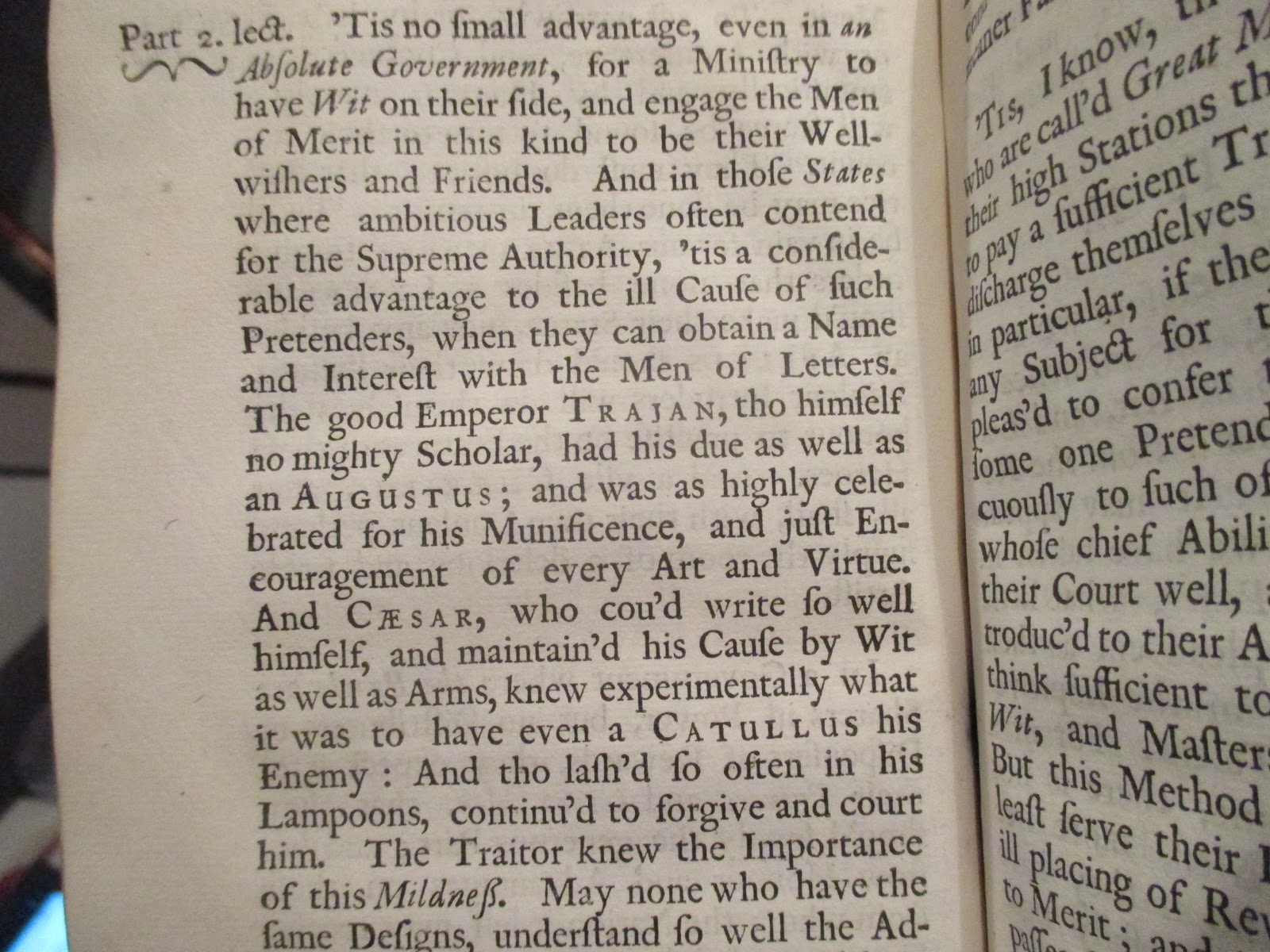
Which one? First of all, we can eliminate the first edition of 1711, as it did not yet include Gribelin’s plates (except for the medallion); and it contained generic woodcut ornaments that this edition lacks. Of the editions prior to 1743 that did contain Gribelin’s plates, we must choose between the 1714, 1723, 1727, 1732, and 1737-8 editions. Page 228 contains the smoking gun:

Vol. I, p. 228.
The sharp “s” (ß) in “Mildness” towards the bottom of the page occurs only in the 1711 and 1714 editions. In subsequent editions, it appears as a long “s” followed by a short one (ʃs). We can eliminate the 1711 edition, for reasons given above. We can also eliminate it for another reason: in the 1711 edition, the word carries over to the next line and is therefore hyphenated (“Mild-neß”). For additional evidence, look at the word “Absolute” near the top of the page. The “a” is upper-case; this occurs only in the 1711, 1714, and 1737 editions. But again, 1737 lacks the sharp “s”.

Therefore, by process of elimination, this “1743” edition is essentially the 1714 second edition, with a few pages containing missing plates recreated and inserted. These insertions are the only things entitling us to call this a “1743” edition. And the fact that the recreated plates are by John Brooks is the only thing entitling us to call this a “Dublin” edition. In all other respects, it’s not an “edition” at all: it is largely the 1714 London second edition.

All of this leads me to other questions for which I have no answers, such as:


  • How did a bunch of sheets of the 1714 edition, and missing precisely the same pages, end up in Dublin, to be re-issued after so many years?
  • Why did it call itself “the fourth edition”, an honour exclusive to the 1727 edition?
  • Were the second and third volumes ever published, or did publication cease after the first?

Wednesday, November 1, 2017

Addendum: English Editions of Shaftesbury

Back in November 2015 I wrote a post entitled “English Editions of Shaftesbury’s Characteristicks”. In it, I reviewed William E. Alderman’s 1967 paper of the same name, bringing his otherwise excellent list up to date, and adding a few other scraps of knowledge of my own on the subject. I am taking this opportunity to add something else that has just come to light.

Among other things, I had claimed that Baskerville’s (1773) “was the first edition since 1737 to reproduce all of Gribelin’s engravings.” In making this claim, I also had the authority of Alderman (p. 326). I have just discovered (on October 31, 2017) that the claim is not entirely correct. In fact, there was a 1743 edition that reproduced those original engravings (or very convincing reproductions – see below).

Furthermore, even more interesting is that this edition is missing from Alderman’s list. I do not know who the printer was, but above is a photo of the Volume I title page as it appeared in the Ebay listing where I came across it.

The listing is for Volume I only. Since it’s an odd volume, I cannot be sure that the other volumes bear the same date — or even that there are other volumes, since this one seems to be unique. Alderman did list a 1743-45 edition, but that was a duodecimo edition sans engravings. I have seen it, and it looks nothing like this. Tantalizingly, he also mentioned an apocryphal “Dublin 1743” edition once listed in a bookseller’s catalogue, which he did not include in his official list because he could not track down a specimen to examine (it had been sold).

In any case, according to the seller’s description, this is an octavo London edition, and from what I can tell at this point, its appearance bears this out: besides containing Gribelin’s engravings, it preserves the pagination of all the previous “official” London editions.

I have taken a gamble and ordered it. Once it arrives, I hope to be able to update this post with further information. In particular, I hope to confirm whether it is a London edition, and I hope to find out if there is any indication of a printer/publisher.

Up until 1732 the work was printed by John Darby. James Purser, who seems to have been successor to Darby’s business in Bartholomew Close, printed the 1737 edition. Was the 1743 edition also published by Purser? The latter was active into the 1740s, so it’s natural to assume so. However, confirming this may be difficult, since for each of the previous “official” editions of Characteristicks the publishing information appears only on the final page of the third volume, not in the first volume that is now on its way to me.

One thing that I should be able to confirm one way or the other is which edition appears on the main title page. The main title page of Purser’s 1737 publication described it as “The Sixth Edition”. Will the 1743 publication refer to itself as the 7th edition? Baskerville’s 1773 version (erroneously) advertised itself as the 5th edition. I have always held that the Baskerville is to be in some sense regarded as one of the “official” editions, for a few reasons:

  1. He somehow owned or had the sanction to use the original Gribelin plates.
  2. He did his best to restore the text and pagination as it had appeared in the earlier official editions from 1711 to 1737.
  3. He had the nerve to print “The Fifth Edition” on the title page, indicating that he regarded his new edition as something more than an act of piracy or clever imitation.
Of these facts, I believe the first is the most pertinent: the moral right to publication seems to have followed somehow the possession of the plates. Alderman points out that Baskerville’s claim to print the 5th edition was recognized as an error, for the errata sheet appearing in some copies — but not mine — corrects this to read “The Seventh Edition”, making it continuous with the 1737 Purser edition. This means that he regarded the 1733 edition and all others after 1737 to be unauthorized. What the “unofficial” 1733, 1743-45, 1749, 1757, and 1758 editions all lack are the Gribelin plates and the pagination corresponding to them.

If it turns out that the main title page of this 1743 edition says “The Sixth Edition”, then I would like to explore further whether it is simply a reissue of sheets from the 1737 edition with a new title page. If, on the other hand, it says “The Seventh Edition”, then this would be evidence that Baskerville — like Alderman — was unaware of its existence.

In any case, this 1743 edition, if it arrives as advertised and turns out to be an "official" edition, represents a small missing link in the rather large gap between 1737 and 1773, the period through which we must trace the hitherto mysterious route by which Baskerville acquired the Gribelin plates.
 

On the Other Hand… 

It may be that the plates are just very convincing knock-offs and that this is a hitherto unknown pirate edition. Despite the graininess of the above photo, I can already spot one difference from the Gribelin plates.

(HINT: It has to do with the location of Gribelin’s name on the volume plate above — assuming that name is even Gribelin’s, as I can't quite make it out. Similar problem with the plate pictured below.)


Also, the frontispiece portrait of Shaftesbury is not where one would expect to find it, which would be facing the main title page, not the volume title page.

Once my order arrives, I will be able to examine more closely the name on the plates. At the moment, despite the low resolution of the photos, it looks like it could be that of John Brooks, an engraver active in Dublin until 1747, when he moved to London. If that is the case, it would confirm my real suspicion, which is that the city of publication is not London, and that this is a specimen of Alderman’s fabled “Dublin 1743” edition.

Whatever the truth, it seems certain that this volume is unique. More to come…


Bibliography

ALDERMAN, William E. “English Editions of Shaftesbury’s CharacteristicsPapers of the Bibliographical Society of America 16.4 (1967), 315-334.

MEYER, H. E. “Correspondence: James Purser, Printer in Bartholomew Close, 1737,” The Library 27 (1972), p. 147.